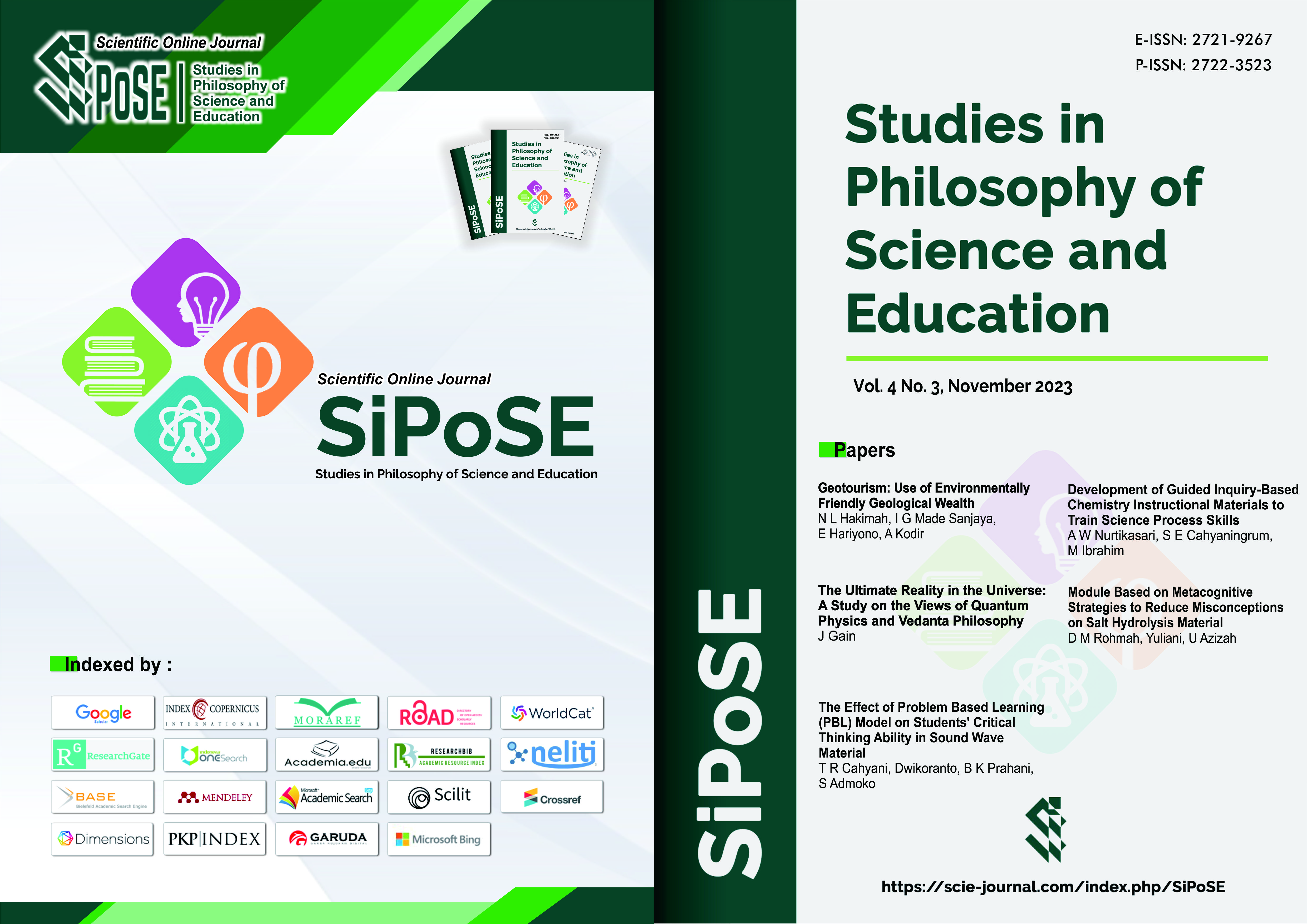
The Effect of Problem Based Learning (PBL) Model on Students' Critical Thinking Ability in Sound Wave Material

Abstract
Education is a process of fostering and developing human resources that are directly beneficial for educating the nation's life. This study aims to describe the critical thinking ability of students in class XI of Senior High School with the application of problem-based learning (PBL) physics learning model. The results of the research are in the form of learning implementation, critical thinking ability, and students' responses. The type of research used is Quasi exsperimental design with Non-equivalent control group design. The research instruments consisted of test observation sheets, critical thinking ability test sheets, and response questionnaire instrument sheets. The results showed the results of the implementation of physics learning with a problem-based learning (PBL) learning model on critical thinking ability, which was implemented with a score of 91.11% and 92.85% in the first meeting and second meeting respectively in the very good category. The problem-based learning (PBL) learning model has a significant effect on the critical thinking ability of students on sound wave material by 81.27%. Students' responses after applying the physics learning of the Problem Based Learning (PBL) model to critical thinking ability get an average percentage of 85.90% in the very good category.
Downloads
References
Amiruddin, M. R. (2020). Pengaruh model pembelajaran Problem Based Learning (PBL) terhadap pemahaman konsep fisika peserta didik kelas X SMA Negeri 14 Makassar [Unpublished undergraduate honors thesis]. Universitas Muhammadiyah Makassar.
Arends, R. I. (2017). Learning to teach. McGraw Hill.
Aripin, W. A., Sahidu, H., & Makhrus, M. (2021). Efektivitas perangkat pembelajaran fisika berbasis model problem based learning untuk meningkatkan kemampuan pemecahan masalah dan kemampuan berpikir kritis peserta didik. Jurnal Penelitian dan Pembelajaran Fisika Indonesia, 3(1). https://doi.org/10.29303/jppfi.v3i1.120
Astuti, S. P. (2017). Keefektifan pembelajaran fisika model problem based learning (pbl) ditinjau dari penguasaan materi, keterampilan memecahkan masalah, dan sikap kerjasama peserta didik SMA [Undergraduate honors thesis, Universitas Negeri Yogyakarta]. ePrints@UNY. https://eprints.uny.ac.id/48130/
Bektiarso, S., Dewi, D. R., & Subiki. (2021). Effect of problem based learning models with 3D thinking maps on creative thinking abilities and physics learning outcomes in high school. Journal of Physics: Conference Series, 1832(1). https://doi.org/10.1088/1742-6596/1832/1/012027
Bestiantoro, D. S. (2019). Pengaruh penerapan argumentasi ilmiah dengan model argument-driven inquiry terhadap literasi fisika peserta didik sma. 561(3), S2–S3.
Budhi, W., & Suwarni, S. (2019). Effect of problem based learning on critical thinking ability on science. Journal of Physics: Conference Series. https://doi.org/10.1088/1742-6596/1175/1/012135
Buhungo, T. J., Arbie, A., Gede, D., Setiawan, E., & Djou, A. (2023). Learning tools quality of problem-based learning model in contextual teaching and learning approach on elasticity and Hooke’s law materials. Jurnal Penelitian Pendidikan IPA, 9(3), 1092–1098. https://doi.org/10.29303/jppipa.v9i3.3127
Dewi, D. T. (2021). Penerapan pembelajaran problem based learning untuk meningkatkan kemampuan berpikir kritis siswa. ACTION : Jurnal Inovasi Penelitian Tindakan Kelas dan Sekolah, 1(2), 149–157. https://doi.org/10.51878/action.v1i2.637
Ennis, R. H. (2015). Critical thinking: A streamlined conception. The Palgrave Handbook of Critical Thinking in Higher Education, 31–47. https://doi.org/10.1057/9781137378057_2
Ennis, R. H. (2016). Critical thinking across the curriculum: A vision. Topoi, 37(1), 165–184. https://doi.org/10.1007/s11245-016-9401-4
Halim, A., Suriana, S., & Mursal, M. (2017). Dampak problem based learning terhadap pemahaman konsep ditinjau dari gaya berpikir siswa pada mata pelajaran fisika. Jurnal Penelitian & Pengembangan Pendidikan Fisika, 3(1), 1–10. https://doi.org/10.21009/1.03101
Imiati, N., Purwaningsih, E., & Sulur. (2016). Telaah bahan ajar materi gelombang dan penyebab kesulitan-kesulitan siswa memahaminya. Seminar Nasional Jurusan Fisika FMIPA UM, 27–36.
Insani, A. (2023). The effect of the Wix website assisted problem-based learning model to improve student learning outcomes on work and energy. Prosiding Seminar Nasional Fisika (E-Journal), XI, 213–218. https://doi.org/10.21009/03.1102.pf29
Jauhari, T., Hikmawati, H., & Wahyudi, W. (2017). Pengaruh model pembelajaran berbasis masalah berbantuan media Phet terhadap hasil belajar fisika siswa kelas X SMAN 1 Gunungsari tahun pelajaran 2015/2016. Jurnal Pendidikan Fisika dan Teknologi, 2(1), 7–12. https://doi.org/10.29303/jpft.v2i1.282
Maulida, S. I., Prihandono, T., & Maryani. (2019). Pengembangan modul fisika gelombang bunyi berbasis REACT untuk kelas XI IPA. Jurnal Pembelajaran Fisika, 8(3), 174–180.
Meilasari, S., M, D., & Yelianti, U. (2020). Kajian model pembelajaran Problem Based Learning (PBL) dalam pembelajaran di sekolah. BIOEDUSAINS:Jurnal Pendidikan Biologi Dan Sains, 3(3), 195–207. https://doi.org/10.31539/bioedusains.v3i2.1849
Muharromah, N. L., Haryanto, S., & Fatiatun. (2023). Penerapan hybrid learning berbasis masalah terhadap critical thinking pembelajaran fisika. Jurnal Pendidikan Fisika, 11(1), 56–66. https://doi.org/10.24252/jpf.v11i1.32452
Nastiti, L. R., Yokhebed, Ramli, M., & Yuliani, H. (2021). Meta-analysis of the effectiveness of problem-based learning towards critical thinking skills in science learning. Journal of Physics: Conference Series. https://doi.org/10.1088/1742-6596/1842/1/012071
Neswary, S. B. A., & Prahani, B. K. (2022). Profile of students’ physics critical thinking skills and application of problem based learning models assisted by digital books in physics learning in high school. Jurnal Penelitian Pendidikan IPA, 8(2), 781–789. https://doi.org/10.29303/jppipa.v8i2.1444
Nursita, N., Darsikin, D., & Syamsu, S. (2015). Pengaruh model pembelajaran berbasis masalah terhadap kemampuan pemecahan masalah hukum Newton pada siswa kelas X SMA Negeri 4 Palu. JPFT (Jurnal Pendidikan Fisika Tadulako Online), 3(2), 18. https://doi.org/10.22487/j25805924.2015.v3.i2.4472
Permata, A. R., Muslim, M., & Suyana, I. (2019). Analisis kemampuan berpikir kritis siswa sma pada materi momentum dan impuls. Prosiding Seminar Nasional Fisika (E-Journal), 8, 9–16. https://doi.org/10.21009/03.snf2019.01.pe.02
Rusman. (2018). Model-model pembelajaran: Mengembangkan profesionalisme guru. Rajawali Pers.
Sagala, Y. D. A., & Simarmata, U. (2021). Analisis dampak penerapan model Problem Based Learning (PBL) terhadap hasil belajar fisika siswa. Jurnal Pendidikan Sains Indonesia, 14(1), 1–13.
Samadun, & Dwikoranto. (2022). Improvement of student’s critical thinking ability sin physics materials through the application of problem-based learning. IJORER : International Journal of Recent Educational Research, 3(5), 534–545. https://doi.org/10.46245/ijorer.v3i5.247
Sanjaya, W. (2017). Strategi pembelajaran berorientasi standar proses pendidikan. Kencana, Pernanda Media Group.
Satumah, S. (2017). Upaya meningkatkan hasil belajar operasi hitung bilangan bulat melalui model number head together berbantuan papan bilangan. Briliant: Jurnal Riset dan Konseptual, 2(2), 184. https://doi.org/10.28926/briliant.v2i2.40
Sawitri, I., Suparmi, & Aminah, N. S. (2016). Pembelajaran fisika berbasis Problem Based Learning (PBL) menggunakan metode eksperimen dan demonstrasi ditinjau dari kemampuan berpikir kritis terhadap prestasi belajar dan keterampilan metakognitif. Jurnal Inkuiri, 5(2), 79–86.
Shishigu, A., Hailu, A., & Anibo, Z. (2018). Problem-based learning and conceptual understanding of college female students in physics. Eurasia Journal of Mathematics, Science and Technology Education, 14(1), 145–154. https://doi.org/10.12973/ejmste/78035
Sugiyono. (2017). Metode penelitian manajemen. Alfabeta.
Sujanem, R., Suwindra, I. N. P., & Suswandi, I. (2020). The effectiveness of problem-based interactive physics e-module on high school students ’ critical thinking. Journal of Physics: Conference Series. https://doi.org/10.1088/1742-6596/1503/1/012025
Supriyanto, Fatirul, A. N., & Walujo, D. A. (2022). Pengaruh strategi problem based learning dan motivasi berprestasi terhadap keterampilan. Jurnal Kumparan Fisika, 5(1), 43–54. https://doi.org/10.33369/jkf.5.1.43-54
Tanjung, A. W. S., Bektiarso, S., & Lesmono, A. D. (2023). Pengaruh model pembelajaran berbasis masalah disertai sumber belajar lingkungan terhadap hasil belajar fisika dan kemampuan berpikir kritis peserta didik. JPF (Jurnal Pendidikan Fisika) Universitas Islam Negeri Alauddin Makassar, 11(1), 67–75.
Trianto. (2015). Mendesain model pembelajaran inovatif, progresif, dan kontekstual: konsep, landasan, dan implementasi pada Kurikulum 2013 (Kurikulum Tematik Integratif/TKI). Kencana, Pernanda Media Group.
Wayudi, M., Suwatno, & Santoso, B. (2020). Kajian analisis keterampilan berpikir kritis siswa sekolah menengah atas. Jurnal Pendidikan Manajemen Perkantoran, 5(1), 67–82. https://doi.org/10.17509/jpm.v4i2.18008
Wijayati. (2018). Pengaruh model pembelajaran problem based learning terhadap hasil belajar fisika siswa kelas X materi momentum dan impuls di SMA Negeri 1 Belitang III [Undergraduate honors thesis, Sriwijaya University]. Sriwijaya University Institutional Repository. https://repository.unsri.ac.id/29681/
Windari, C. O., & Yanti, F. A. (2021). Penerapan model problem based learning untuk meningkatkan keterampilan berpikir kritis pesera didik. Jurnal Penddikan Sains dan Matematika, 9(1).
Yovianda, F., Juliani, R., & Hasibuan, K. A. (2019). Application of Problem Based Learning ( PBL ) to increasing student activity in the subject matter of temperature and heat. Journal of Physics: Conference Series. https://doi.org/10.1088/1742-6596/1317/1/012157
Yusuf, M., & Ardhuha, J. (2022). Pengembangan perangkat pembelajaran model problem based learning untuk meningkatkan pemahaman konsep fisika dan kemampuan berpikir kritis peserta didik. Jurnal Ilmiah Profesi Pendidikan, 7(2), 250–258. https://doi.org/10.29303/jipp.v7i2.457
Copyright (c) 2023 Studies in Philosophy of Science and Education

This work is licensed under a Creative Commons Attribution-NonCommercial-NoDerivatives 4.0 International License.
Copyright Notice
The copyright of the received article once accepted for publication shall be assigned to the journal as the publisher of the journal. The intended copyright includes the right to publish the article in various forms (including reprints). The journal maintains the publishing rights to the published articles.