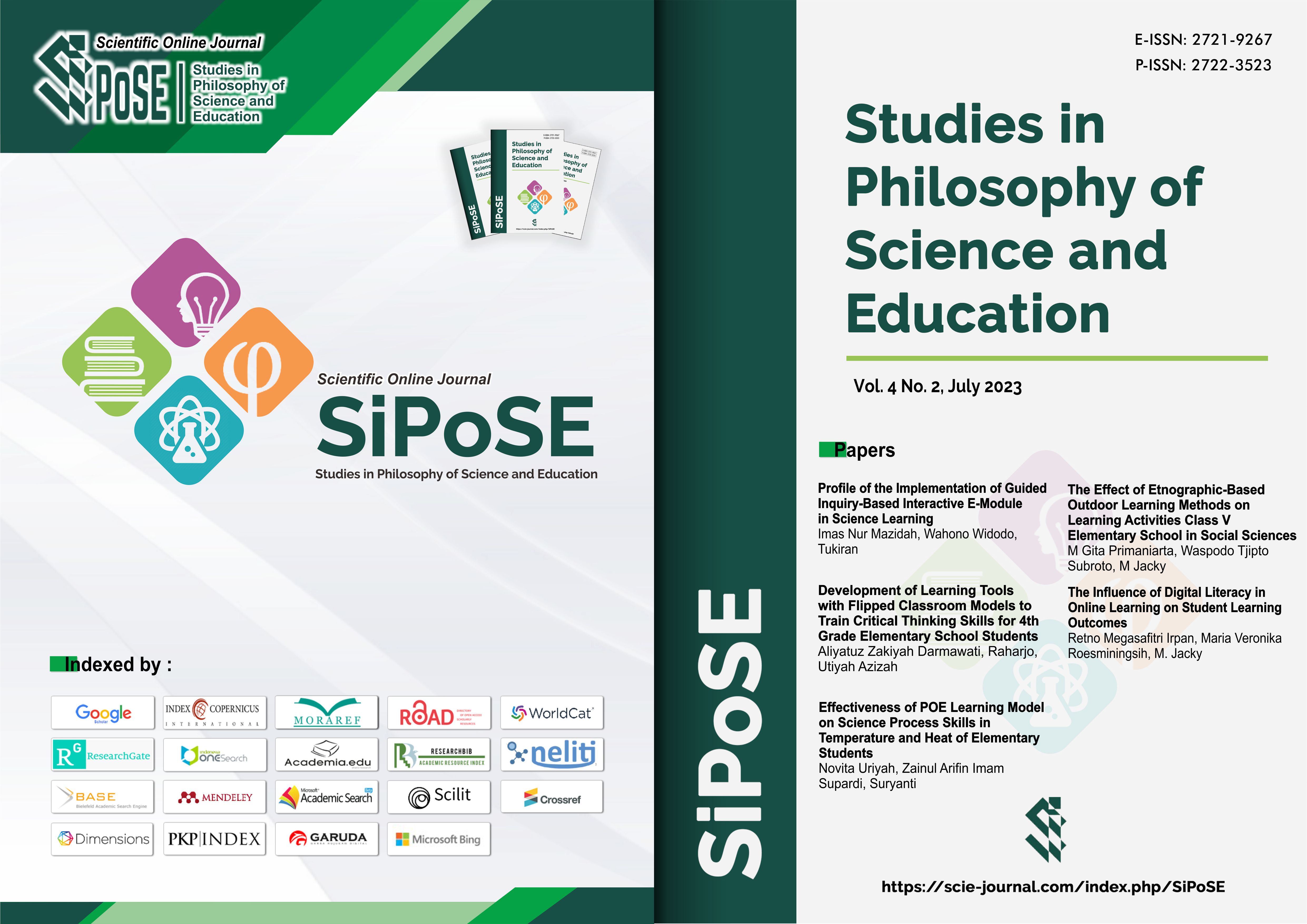
Effectiveness of POE Learning Model on Science Process Skills in Temperature and Heat of Elementary Students

Abstract
This research aims to explain the effectiveness of the Predict-Observe-Explain (POE) learning model on elementary students' science process skills on temperature and heat material. This research was conducted on fifth-grade students at SDN Kalirungkut I/264. This research method is a quasi-experiment with a non-equivalent control group research design. The data was collected through test and non-test (observation) techniques. Based on the N-Gains score test, the score in the experimental group was 58.12697%, which is quite effective. Based on the analysis using effect size on experimental and control class students, it is known that the effect size value is 1.131611, which means that learning with the POE model on temperature and heat material has a high influence on students' science process skills. Based on the results of the research conducted, it can be concluded that the POE learning model is more effective than conventional learning of scientific process skills. This research will help students improve their fundamental scientific process skills using the POE model. In prior research, no one has tried to examine the topic of temperature and heat and no one has calculated the effectiveness of the POE model on science process skills using effect size.
Downloads
References
Adebayo, F., & Olufunke, B. T. (2015). Generative and predict-observe-explain instructional strategies: Towards enhancing basic science practical skills of lower primary school pupils. International Journal of Elementary Education, 4(4), 86–92. https://doi.org/10.11648/j.ijeedu.20150404.12
Alfarizi, M. A. S., Maknun, D., & Mulyani, A. (2023). Penerapan model pembelajaran predict observe explain untuk meningkatkan higher order thinking skill siswa pada materi pencemaran lingkungan di SMAN 6 Tambun Selatan. Jurnal Pendidikan Biologi Indonesia, 1–8.
Anggraini, N. D., Purwanto, A., & Sakti, I. (2018). Pengaruh model inkuiri terbimbing terhadap keterampilan proses sains siswa pada materi usaha dan energi kelas X IPA SMAN 3 Bengkulu Tengah. Jurnal Kumparan Fisika, 1(8), 20–27.
Asmani, J. M. (2011). Tips menjadi guru inspiratif, kreatif, dan inovatif. Diva Press.
Astuti, T. W., Ariyanto, J., & Dwiastuti, S. (2023). Pengaruh model pembelajaran predict observe explain (poe) terhadap kemampuan berpikir kritis dan keaktifan belajar siswa. Jurnal Penelitian Sains Pendidikan, 3(1), 1–14.
Azizah, N., Sujana, A., & Isrok’atun. (2016). Penerapan pendekatan somatis auditori visual intelektual pada materi sumber energi bunyi untuk meningkatkan hasil belajar siswa. Jurnal Pena Ilmiah, 1(1), 491–500.
Cindikia, M., Achmadi, H. R., Prahani, B. K., & Mahtari, S. (2020). Profile of students’ problem solving skills and the implementation of assisted guided inquiry model in senior high school. Studies in Learning and Teaching (SiLET), 1(1), 52–62. https://doi.org/10.46627/silet.v1i1.22
Fatmawati, R. D., & Mariana, N. (2022). Penerapan pembelajaran STEAM melalui aktivitas make a non stop fountain untuk meningkatkan kreativitas siswa di sekolah dasar. Jurnal Penelitian Pendidikan Guru Sekolah Dasar, 10(16), 1248–1260.
Furqani, D., Feranie, S., & Winarno, N. (2018). The effect of Predict-Observe-Explain (POE) strategy on students’ conceptual mastery and critical thinking in learning vibration and wave. Journal of Science Learning, 2(1). https://doi.org/10.17509/jsl.v2i1.12879
Government of Republic of Indonesia. (2015). Peraturan pemerintah republik indonesia nomor 13 tahun 2015 tentang perubahan kedua atas peraturan pemerintah nomor 19 tahun 2005 tentang standar nasional pendidikan.
Hilario, J. S. (2015). The use of Predict-Observe-Explain-Explore (POEE) as a new teaching strategy in general chemistry-laboratory. International Journal of Education and Research, 3(2), 37–48.
Hosnan. (2014). Pendekatan saintifik dan kontekstual dalam pembelajaran abad 21. Ghalia Indonesia.
Kearney, M., Treagust, D. F., Yeo, S., & Zadnik, M. G. (2001). Student and teacher perceptions of the use of multimedia supported predict-observe-explain tasks to probe understanding. Research in Science Education, 31, 589–615. https://doi.org/10.1023/A:1013106209449
Lolotandung, R., Ruminiati, & Atok, A. R. A. (2017). Pendekatan SAVI terhadap keaktifan bertanya dan mengemukakan ide siswa dalam proses pembelajaran. Prosiding TEP & PDs Transformasi Pendidikan Abad 21 Pascasarjana Universitas Negeri Malang, 901–907.
Masyhud, M. S. (2018). Metode penelitian pendidikan. Lembaga Pengembangan Manajemen dan Profesi Kependidikan (LPMPK).
Minister of Education and Culture. (2016). Peraturan menteri pendidikan dan kebudayaan nomor 22 tahun 2016 tentang standar proses pendidikan dasar dan menengah. https://repositori.kemdikbud.go.id/4790/2/Permendikbud_Tahun2016_Nomor022_Lampiran.pdf
Muhsam, J. (2023). Pengaruh model pembelajaran Predict Observe Explain (POE) berbasis media konkret terhadap hasil belajar IPA siswa kelas IV MIS Al-Fitrah Kota Kupang. Anthor Educational and Learning Journal, 2(2), 224–231.
Nuraini, N., Karyanto, P., & Sudarisman, S. (2014). Pengembangan modul berbasis POE (Predict, Observe, and Explain) disertai roundhouse diagram untuk memberdayakan keterampilan proses sains dan kemampuan menjelaskan siswa kelas X SMA Negeri 5 Surakarta (Penelitian dan pengembangan materi pencemaran lingkungan). Bioedukasi, 7(1), 37–43.
Ozedmir, H., Bag, H., & Bilen, K. (2011). Effect of laboratory activities designed based on Prediction-Observation-Explanation (POE) strategy on pre-service science teachers’ understanding of acid base subject. Wastern Anatolia Journal of Educational Science, 169–174.
Rahayu, A. H., & Anggraeni, P. (2017). Analisis profil keterampilan proses sains siswa sekolah dasar di kabupaten Sumedang. Jurnal Pesona Dasar, 5(2), 22–33.
Rozana, T., Jufrida, & Basuki, F. R. (2018). Penerapan model pembelajaran POE untuk meningkatkan keterampilan proses sains kelas XI SMAN 11 Jambi. Jurnal Edufisika, 3(2), 66–80.
Samatowa, U. (2006). Bagaimana membelajarkan IPA di Sekolah Dasar. Depdiknas.
Sholahuddin, A., Yuanita, L., Supardi, Z. A. I., & Prahani, B. K. (2020). Applying the cognitive style-based learning strategy in elementary schools to improve students’ science process skills. Journal of Turkish Science Education, 17(2), 289–301.
Sinulingga, P., Hartanto, T. J., & Adwitya, W. (2015). Melatih keterampilan proses sains siswa melalui penerapan model pembelajaran POE (Prediction, Observation, Explanation). Jurnal Vidya Karya, 30(1), 7–14.
Sukarno, Permanasari, A., & Hamidah, I. (2013). The profile of Science Process Skill (SPS) student at secondary high school (Case study in Jambi). International Journal of Scientific Engineering and Research, 1(1), 79–83.
Suparno, P. (2013). Metodologi pembelajaran fisika konstruktivistik & menyenangkan. Penerbit Universitas Sanata Dharma.
Suprapto, N., Prahani, B. K., & Cheng, T. H. (2021). Indonesian curriculum reform in policy and local wisdom: Perspectives from science education. Jurnal Pendidikan IPA Indonesia, 10(1), 69–80. https://doi.org/10.15294/jpii.v10i1.28438
Syamsiana, F., Suyatno, S., & Taufikurahmah, T. (2018). The effectiveness of using POE (Predict-Observe-Explain) strategy on students’ learning result of reaction rate chapter in SMA. JPPS (Jurnal Penelitian Pendidikan Sains), 7(2), 1507-15.12. https://doi.org/10.26740/jpps.v7n2.p1507-1512
Utama, E. G. (2019). Pengaruh model pembelajaran POE (Predict, Observe and Explain) terhadap keterampilan proses sains SD kelas V ditinjau dari keterampilan metakognitif. Jurnal Pendidikan Dasar Indonesia, 4(2), 46–52.
Warsono, & Hariyanto. (2012). Pembelajaran aktif: Teori dan assesmen. Remaja Rosdakarya.
Wibowo, A. S. B., Suryanti, & Supardi, Z. A. I. (2022). Penggunaan media pembelajaran IPA model POE (Predict Observe Explain) untuk melatih kemampuan HOTS siswa SD. Edukatif: Jurnal Ilmu Pendidikan, 4(4), 6343–6352.
Widayanti, E. Y. (2016). Penguasaan keterampilan proses sains dasar siswa madrasah ibtidaiyah (Studi pada madrasah mitra STAIN Ponorogo). Kodifikasia, 9(1), 171. https://doi.org/10.21154/kodifikasia.v9i1.465
Widyaningrum, R., Sarwanto, & Karyanto, P. (2013). Pengembangan modul berorientasi POE (Predict, Observe, Explain) berwawasan lingkungan pada materi pencemaran untuk meningkatkan hasil belajar siswa. Bioedukasi, 6(1), 100–117.
Wu, Y.-T., & Tsai, C.-C. (2005). Effects of constructivist-oriented instruction on elementary school students’ cognitive structures. Journal of Biological Education, 39(3), 113–119. https://doi.org/10.1080/00219266.2005.9655977
Yulianti, S. H., Juanengsih, N., & Mardiati, Y. (2018). POE learning model: The effect on student science process skills on the coordination system concept. Jurnal Penelitian Pendidikan Sains, 8(7). https://doi.org/10.26740/jpps.v8n1.p%25p
Copyright (c) 2023 Studies in Philosophy of Science and Education

This work is licensed under a Creative Commons Attribution-NonCommercial-NoDerivatives 4.0 International License.
Copyright Notice
The copyright of the received article once accepted for publication shall be assigned to the journal as the publisher of the journal. The intended copyright includes the right to publish the article in various forms (including reprints). The journal maintains the publishing rights to the published articles.