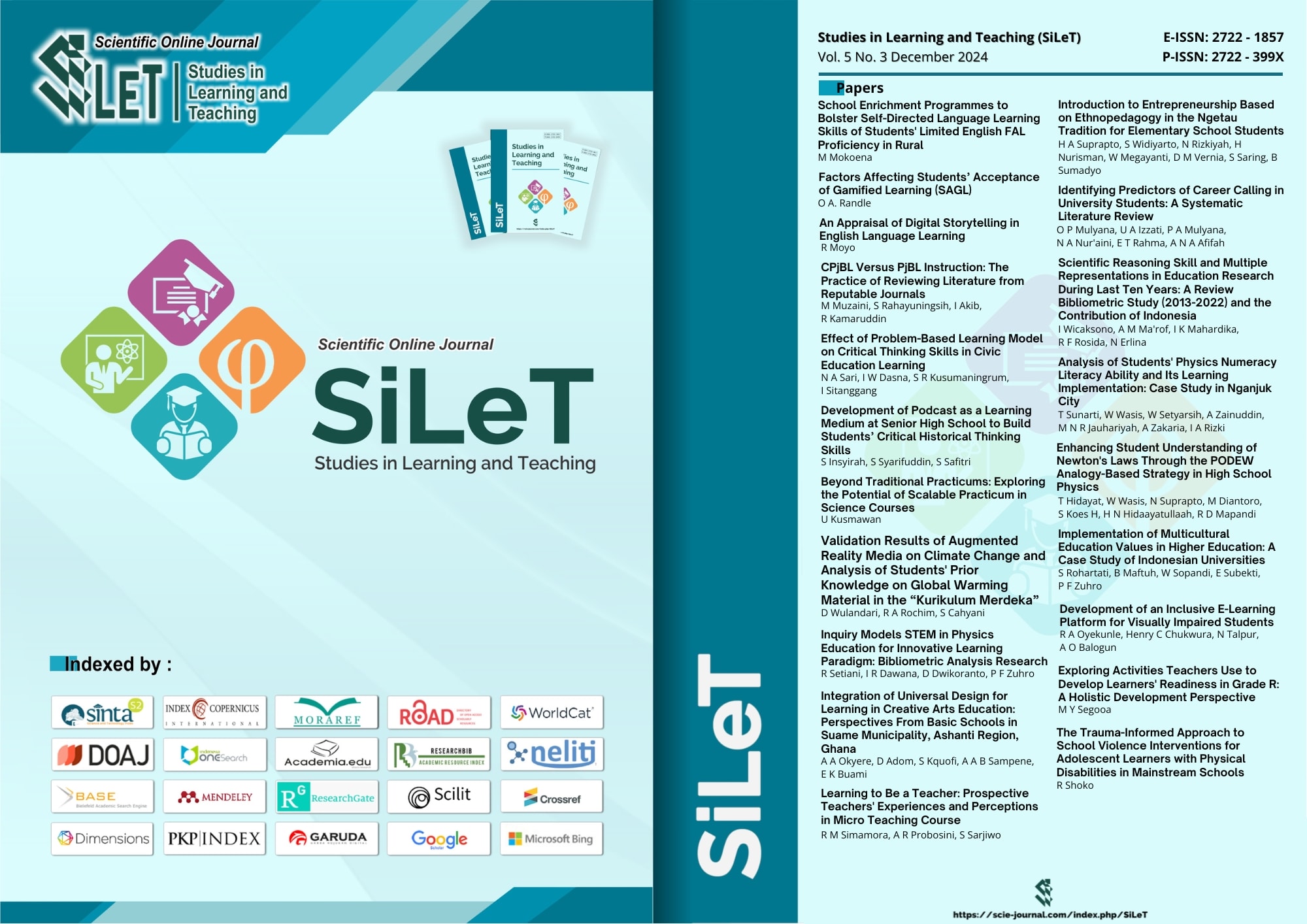
Inquiry Models STEM in Physics Education for Innovative Learning Paradigm: Bibliometric Analysis Research

Abstract
The aim of this research was to investigate research trends on Inquiry STEM topic in the context of physics education and conduct a bibliometric analysis to understand the development of research in this domain. Data were collected from the Scopus database using keywords relevant to Inquiry STEM and physics. The approach used in the analysis was the bibliometric method by utilising the Scopus database and VOSviewer, which resulted in 62 relevant documents. The results showed that the use of Inquiry STEM in physics education has become an increasingly popular topic over the past ten years, despite fluctuations in publication rates. This indicates potential challenges that need to be further explored in the future. Further research of Inquiry STEM in physics education could be helpful in improving students' critical thinking skills and motivation, given the evidence that this instructional model has demonstrated effectiveness in improving students' problem-solving abilities, critical thinking, and motivation. However, it's worth noting that this research has limitations due to its sole reliance on one database, namely Scopus, for data collection. Therefore, it is advisable for future research on Inquiry STEM in physics education to incorporate the utilization of other databases besides Scopus to ensure a broader range of data is considered.
Downloads
References
Abaniel, A. (2021). Enhanced conceptual understanding, 21st century skills and learning attitudes through an open inquiry learning model in Physics. JOTSE, 11(1), 30–43. https://doi.org/10.3926/jotse.1004
Abdurrahman, A., Nurulsari, N., Maulina, H., & Ariyani, F. (2019). Design and validation of inquiry-based STEM learning strategy as a powerful alternative solution to facilitate gift students facing 21st century challenging. Journal for the Education of Gifted Young Scientists, 7(1), 33–56. https://doi.org/10.17478/jegys.513308
Bao, L., & Koenig, K. (2019). Physics education research for 21st century learning. Disciplinary and Interdisciplinary Science Education Research, 1(1), 1–12. https://doi.org/10.1186/s43031-019-0007-8
Brookes, D. T., Ektina, E., & Planinsic, G. (2020). Implementing an epistemologically authentic approach to student-centered inquiry learning. Physical Review Physics Education Research, 16(2), 20148. https://doi.org/10.1103/PhysRevPhysEducRes.16.020148
Chen, R. H. (2021). Fostering students’ workplace communicative competence and collaborative mindset through an inquiry-based learning design. Education Sciences, 11(1), 17. https://doi.org/10.3390/educsci11010017
Chu, S. K. W., Reynolds, R. B., Tavares, N. J., Notari, M., & Lee, C. W. Y. (2021). 21st century skills development through inquiry-based learning from theory to practice. Springer. https://doi.org/10.1007/978-981-10-2481-8
Dawana, I. R., Dwikoranto, Setiani, R., & Marsini. (2022a). E-book learning research in physics education during the last five years: A review and bibliometric study. Journal of Physics: Conference Series, 2392(1), 12016. https://doi.org/10.1088/1742-6596/2392/1/012016
Dawana, I. R., Setyarsih, W., Suprapto, N., & Dwikoranto, D. (2022b). The effectiveness of virtual class-based e-learning with video-assisted google classroom as a physics learning media (2016-2020). Momentum: Physics Education Journal, 6(2), 188–198. https://doi.org/10.21067/mpej.v6i2.5849
Dawana, I., & Dwikoranto, D. (2024). Characteristics of high school physics problem-solving skills and integrating the pbl model assisted by e-book. Prisma Sains : Jurnal Pengkajian Ilmu dan Pembelajaran Matematika dan IPA IKIP Mataram, 12(1), 30-48. https://doi.org/10.33394/j-ps.v12i1.8467
De Jong, T. (2019). Moving towards engaged learning in STEM domains; there is no simple answer, but clearly a road ahead. Journal of Computer Assisted Learning, 35(2), 153–167. https://doi.org/10.1111/jcal.12337
Deák, C., Kumar, B., Szabó, I., Nagy, G., & Szentesi, S. (2021). Evolution of new approaches in pedagogy and STEM with inquiry-based learning and post-pandemic scenarios. Education Sciences, 11(7), 319. https://doi.org/10.3390/educsci11070319
Dewi, H. R., Mayasari, T., & Handhika, J. (2019). Increasing creative thinking skills and understanding of physics concepts through application of stem-based inquiry. Jurnal Penelitian Pendidikan IPA, 4(1), 25–30. https://doi.org/10.26740/jppipa.v4n1.p25-30
Dwikoranto, D., Surasmi, W. A., Kurniawan, B., Dawana, I. R., & Bergsma, L. N. (2023). Utilization of universities’ massive online open courses in learning management system: research trends and bibliometric analysis. IJORER: International Journal of Recent Educational Research, 4(3), 383–398. https://doi.org/10.46245/ijorer.v4i3.380
Dwikoranto., Dawana, I. R. & R Setiani. (2023). Validity of teaching modules with problem-based learning (PBL) model assisted by e-book to improve problem-solving skills on renewable energy material and implementation of independent learning curriculum. Journal of Physics: Conference Series 2623 (2023) 012015. https://doi.org/10.1088/1742-6596/2623/1/012015
Ellermeijer, T., & Tran, T.-B. (2021). Stem, inquiry practices and technology in physics education. Fundamental Physics and Physics Education Research, 127–161. https://doi.org/10.1007/978-3-030-52923-9_12
Falloon, G., Hatzigianni, M., Bower, M., Forbes, A., & Stevenson, M. (2020). Understanding K-12 STEM education: A framework for developing STEM literacy. Journal of Science Education and Technology, 29, 369–385. https://doi.org/10.1007/s10956-020-09823-x
Gao, P., Meng, F., Mata, M. N., Martins, J. M., Iqbal, S., Correia, A. B., Dantas, R. M., Waheed, A., Xavier Rita, J., & Farrukh, M. (2021). Trends and future research in electronic marketing: A bibliometric analysis of twenty years. Journal of Theoretical and Applied Electronic Commerce Research, 16(5), 1667–1679. https://doi.org/10.3390/jtaer16050094
Goh, P. S.-C., & Abdul-Wahab, N. (2020). Paradigms to drive higher education 4.0. International Journal of Learning, Teaching and Educational Research, 19(1), 159–171. https://doi.org/10.26803/ijlter.19.1.9
Guo, Y. M., Huang, Z. L., Guo, J., Li, H., Guo, X. R., & Nkeli, M. J. (2019). Bibliometric analysis on smart cities research. Sustainability (Switzerland), 11(13). https://doi.org/10.3390/su11133606.
Herayanti, L., Widodo, W., Susantini, E., & Gunawan, G. (2020). The effectiveness of blended learning model based on inquiry collaborative tutorial toward students’ problem-solving skills in physics. Journal for the Education of Gifted Young Scientists, 8(3), 959–972. https://doi.org/10.17478/jegys.675819
Ješková, Z., Lukáč, S., Šnajder, Ľ., Guniš, J., Klein, D., & Kireš, M. (2022). Active learning in STEM education with regard to the development of inquiry skills. Education Sciences, 12(10), 686. https://doi.org/10.3390/educsci12100686
Karakus, M., Ersozlu, A., & Clark, A. C. (2019). Augmented reality research in education: A bibliometric study. Eurasia Journal of Mathematics, Science and Technology Education, 15(10). https://doi.org/10.29333/ejmste/103904
Kartini, F. S., Widodo, A., Winarno, N., & Astuti, L. (2021). Promoting student’s problem-solving skills through stem project-based learning in earth layer and disasters topic. Journal of Science Learning, 4(3), 257–266. https://doi.org/10.17509/jsl.v4i3.27555
Lin, G.-X., Nan, J.-N., Chen, K.-T., Sun, L.-W., Tai, C.-T., Jhang, S.-W., Chen, C.-M., Rui, G., & Hu, B.-S. (2022). Bibliometric analysis and visualization of research trends on oblique lumbar interbody fusion surgery. International Orthopaedics, 46(7), 1597–1608. DOI: 10.3389/fsurg.2022.976708
Matthee, M., & Turpin, M. (2019). Teaching critical thinking, problem solving, and design thinking: Preparing IS students for the future. Journal of Information Systems Education, 30(4), 242–252.
Meyer, M. W., & Norman, D. (2020). Changing design education for the 21st century. She Ji: The Journal of Design, Economics, and Innovation, 6(1), 13–49. https://doi.org/10.1016/j.sheji.2019.12.002
Nurwahyunani, A. (2021). Literature review: a STEM approach to improving the quality of science learning in Indonesia. Journal for the Education of Gifted Young Scientists, 9(5), 11–17. https://doi.org/10.17478/jegys.853203
Palupi, B. S., & Subiyantoro, S. (2020). The effectiveness of guided inquiry learning (GIL) and problem-based learning (PBL) for explanatory writing skill. International Journal of Instruction, 13(1), 713–730. https://doi.org/10.29333/iji.2020.13146a
Peffer, M. E., & Ramezani, N. (2019). Assessing epistemological beliefs of experts and novices via practices in authentic science inquiry. International Journal of STEM Education, 6, 1–23. https://doi.org/10.1186/s40594-018-0157-9
Samadun, S., Setiani, R., Dwikoranto, D., & Marsini, M. (2023). Effectiveness of inquiry learning models to improve students’ critical thinking ability. IJORER: International Journal of Recent Educational Research, 4(2), 203–212. https://doi.org/10.46245/ijorer.v4i2.277
Schwartz, R. S., Lederman, J. S., & Enderle, P. J. (2023). Scientific inquiry literacy: The missing link on the continuum from science literacy to scientific literacy. In Handbook of Research on Science Education (pp. 749–782). Routledge.
Sutaphan, S., & Yuenyong, C. (2019). STEM education teaching approach: Inquiry from the context based. Journal of Physics: Conference Series, 1340(1), 12003. https://doi.org/10.1088/1742-6596/1340/1/012003
Tlili, A., Huang, R., Shehata, B., Liu, D., Zhao, J., Metwally, A. H. S., Wang, H., Denden, M., Bozkurt, A., & Lee, L.-H. (2022). Is Metaverse in education a blessing or a curse: A combined content and bibliometric analysis. Smart Learning Environments, 9(1), 1–31. https://doi.org/10.1186/s40561-022-00205-x
Tohani, E., & Aulia, I. (2022). Effects of 21st century learning on the development of critical thinking, creativity, communication, and collaboration skills. Journal of Nonformal Education, 8(1), 46–53. https://doi.org/10.15294/jne.v8i1.33334
Uğur, S., Duygu, E., ŞEN, Ö. F., & Kirindi, T. (2020). The effects of STEM education on scientific process skills and STEM awareness in simulation based inquiry learning environment. Journal of Turkish Science Education, 17(3), 387–405. https://doi.org/10.54097/ehss.v6i.4427
Yulianingsih, S., Kurnia, D., & Julia, J. (2020). Pemetaan sistematik dalam Topik Kajian Problem Posing Berdasarkan Analissis Bibliometrik. Jurnal Pena Ilmiah, 3(2). DOI: https://doi.org/10.14203/j.baca.v43i2.854
Zhai, L. (2019). A inquiry teaching mode based on STEM education. International Journal of Emerging Technologies in Learning (Online), 14(17), 44. https://doi.org/10.3991/ijet.v14i17.11204
Copyright (c) 2024 Studies in Learning and Teaching

This work is licensed under a Creative Commons Attribution-NonCommercial-NoDerivatives 4.0 International License.