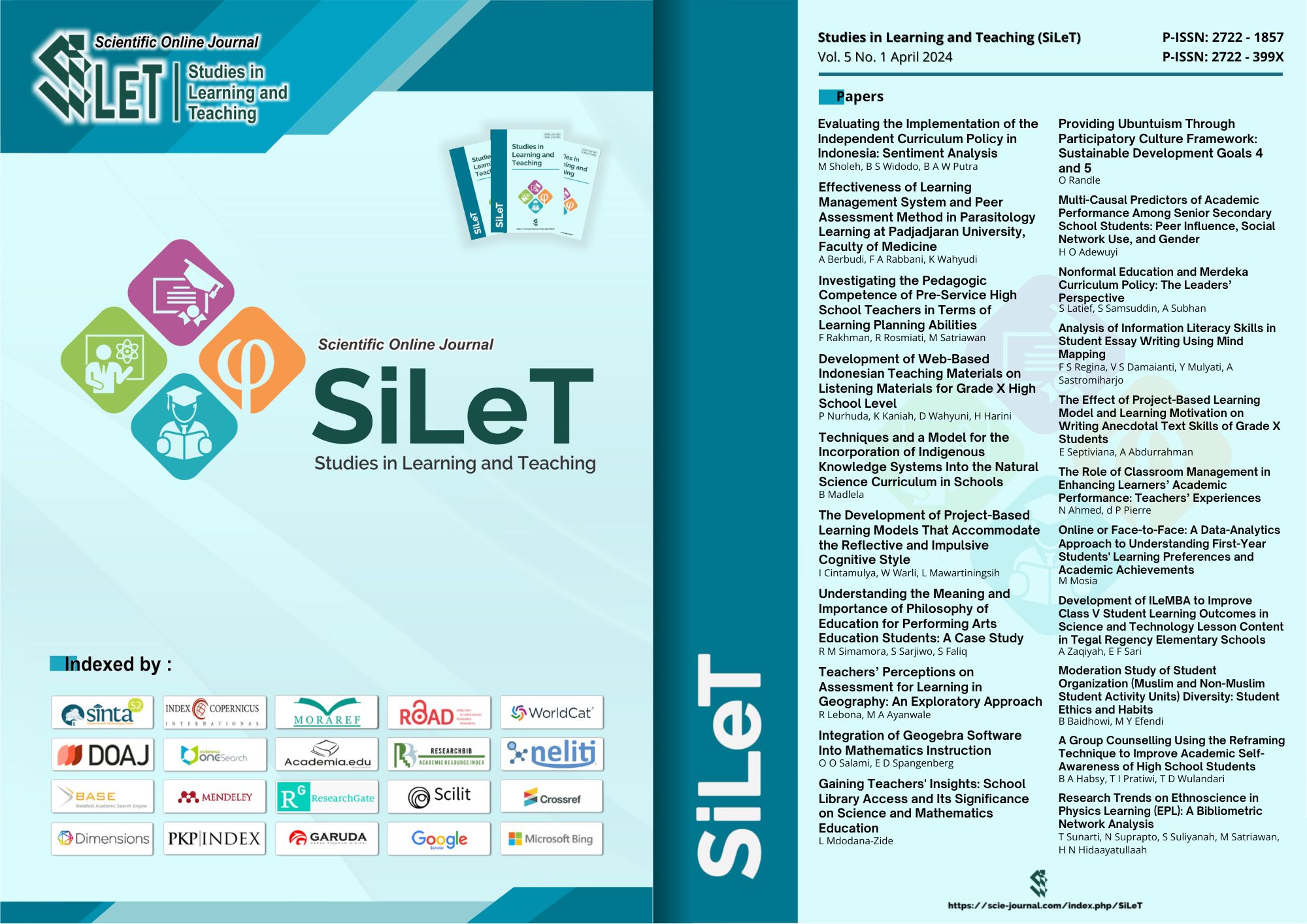
Gaining Teachers' Insights: School Library Access and Its Significance on Science and Mathematics Education

Abstract
Access to libraries significantly enhances Science and Mathematics education, offering diverse pathways for learners to engage with concepts using media and digital literacy skills. However, the contribution of school libraries to these subjects remains unexplored despite attention to learners and Science, Technology, Engineering and Mathematics education. This study examined insights from Science and Mathematics teachers regarding the role of library resources, such as books, research materials, and interactive tools, in supporting students' comprehension, critical thinking, and problem-solving skills in these subjects. Employing a qualitative approach within an interpretive paradigm, the research used a multiple-case study design. Data collection involved questionnaires administered to 12 teachers from six purposefully selected schools. Findings indicated that school library access positively impacts student engagement in Science and Mathematics education as resources facilitate better understanding and application of concepts, encourage independent exploration, nurture inquiry-based learning, act as bridges in the integration of subjects, mitigate resource disparities, and provide teacher professional development. The study concludes by not only advocating a heightened prominence on library access in schools but also positions the teachers as key elements in channeling learners toward the use of these invaluable informative hubs to shape the landscape of Science and Mathematics education. Thus, the study opens the door for a paradigm shift toward the optimization of library access for all learners to harness the unrealized potential within the pages and digital interfaces of school libraries by illuminating the transformational significance of libraries in Science and Mathematics.
Downloads
References
Aouaf, S., Azzouzi, L., & Housni, H. (2023). Perceived barriers to critical thinking development: The student’s view. International Journal of Linguistics, Literature and Translation, 6(2), 63-69. https://doi.org/10.32996/ijllt.2023.6.2.10
Aspers, P., & Corte, U. (2019). What is qualitative in qualitative research? Qualitative Sociology, 42, 139-160. https://doi.org/10.1007/s11133-019-9413-7
Azubogu, N. (2020). The relevance of school library to students' performance in mathematics: a comparative study of students' performance in West African School Certificate (WASC) and National Examinations Council (NECO) in public schools in Orlu education zone of Imo state, Nigeria. Information Technologist, 17(1).
Baek, J. Y. (2013). Public libraries as places for STEM learning: An exploratory interview study with eight librarians. Space Science Institute, 1-17.
Bean, J. C., & Melzer, D. (2021). Engaging Ideas: The professor's guide to integrating writing, critical thinking, and active learning in the classroom. John Wiley & Sons.
Beneyat-Dulagan, M. T., & Cabonero, D. A. (2023). Exploring library activities, learning spaces, and challenges encountered towards the establishment of a learning commons. Evidence Based Library and Information Practice, 18(1), 3-23. https://doi.org/10.18438/eblip30164
Cropley, A. (2019). Introduction to qualitative research methods. A research handbook for patient and public involvement researchers. https://doi.org/10.7765/9781526136527.00012
European Commission/EACEA/Eurydice. (2022). Increasing achievement and motivation in mathematics and science learning in schools. European Education Area. https://education.ec.europa.eu/news/increasing-achievement-and-motivation-in-mathematics-and-science-learning-in-schools
Evimalinda, R., Situmorang, E. L., Butarbutar, R. D., & Ditakristi, A. H. V. (2022). The role of christian religious education teachers in building student’s 6c skills in the era 4.0. International Conference on Theology, Humanities, and Christian Education (ICONTHCE 2021), 192-196. https://doi.org/10.2991/assehr.k.220702.044
Fadillah, R. N., Jatmiko, B., & Widodo, W. (2022) Critical thinking profile of senior high school students in terms of argumentation-based learning. Studies in Learning and Teaching, 3(3), 149–162. https://doi.org/10.46627/silet.v3i3.174
Hart, G., & Nassimbeni, M. (2016). Libraries and a “Better life for all”: The politics, processes, and promises of the South African LIS transformation charter. Library Trends, 65(2), 198-216. https://doi.org/10.1353/lib.2016.0031
Horváth, A., Baïdak, N., Motiejunaite-Schulmeister, A., & Noorani, S. (2022). Increasing achievement and motivation in mathematics and science learning in schools. European Education and Culture Executive Agency, European Commission. https://doi.org/10.2797/031821
Itsekor, V. O., & Nwokeoma, N. M. (2017). The Importance of the use of libraries and the need for a reading culture. Acta Universitatis Lodziensis. Folia Librorum, 1(24), 97–110. https://doi.org/10.18778/0860-7435.24.07
Jatmiko, B., Widodo, W., Martini, B., Wicaksono, I., & Pandiangan, P. (2016). Effectiveness of the INQF-based learning on a general physics for improving student’s learning outcomes. Journal of Baltic Science Education, 15(4), 441. https://doi.org/10.33225/jbse/16.15.441
Kusuma, A. E., & Susantini, E. (2022). The effect of rode learning model on enhancing students communication skills. Studies in Learning and Teaching, 3(3), 132-140. https://doi.org/10.46627/silet.v3i3.170
Kusuma, A. E., Wasis, Susantini, E., & Rusmansyah. (2020). Physics innovative learning: RODE learning model to train student communication skills. Journal of Physics: Conference Series, 1422(1). https://doi.org/10.1088/1742-6596/1422/1/012016
Maneen, C. A. (2016). A case study of arts integration practices in developing the 21st-century skills of critical thinking, creativity, communication, and collaboration. [Doctoral dissertation, Gardner-Webb University]. ProQuest https://www.proquest.com/openview/84dd2c4ebc886024bf0b1cfef085bc83/
Mondal, H. (2021). Overviews of knowledge management with the role of library and library professionals in 21st century. Knowledge Management in Higher Education Institutions, 5.
Murphy, J. E., Koltutsky, L., Lenart, B., McClurg, C., & Stoeckle, M. (2020). Academic librarian collaborations in inquiry based learning: A case study, reflections and strategies. Partnership, 15(2), 1-21. https://doi.org/10.21083/partnership.v15i2.5732
Nganga, L. (2019). Preservice teachers perceptions of teaching for global mindedness and social justice: Using the 4Cs (Collaboration, Critical thinking, Creativity and Communication) in teacher education. Journal of Social Studies Education Research, 10(4), 26-57.
Obilor, E. I. (2023). Convenience and purposive sampling techniques: Are they the same? International Journal of Innovative Social & Science Education Research, 11(1), 1-7.
O'Brien, B., O'Brien, S., & O'Hara, J. (2023). School library provision in the Republic of Ireland. School Libraries Worldwide, 28(1), 54-77. https://doi.org/10.29173/slw8516
Olajide, O., Oyeniran, K. G., Anyakorah, O. Z., Omolehin, R. J., & Lucas-Elumah, B. A. (2023). Influence of school library on implementing qualitative science education in Nigeria: Impediments and the possibilities. Communicate: Journal of Library and Information Science, 25(1), 228-246.
Polat, Ö., & Aydın, E. (2020). The effect of mind mapping on young children’s critical thinking skills. Thinking Skills and Creativity, 38, 100743. https://doi.org/10.1016/j.tsc.2020.100743
Rameli, M. R. M., & Kosnin, A. M. (2016). Challenges in mathematics learning: A study from school students' perspective. ReasearchGate.
Scottish Government. (2018). Vibrant libraries, thriving schools: A national strategy for school libraries in Scotland 2018–2023. https://scottishlibraries.org/media/2108/vibrant-libraries-thriving-schools.pdf
Setiani, R. (2023). Research trend of inquiry learning in elementary school in the last 10 years: To determine the opportunities in the future. Studies in Learning and Teaching, 4(1), 144-156. https://doi.org/10.46627/silet.v4i1.214
Shava, G. N., Hleza, S., Tlou, F., Shonhiwa, S., & Mathonsi, E. (2021). Qualitative content analysis utility, usability and processes in educational research. International Journal of Research and Innovation in Social Science, 5(7), 553-558.
Soulen, R. R., & Tedrow, L. (2022). Students’ frequency of access to school library materials in transformative times. Journal of Librarianship and Information Science, 54(4), 622-639. https://doi.org/10.1177/09610006211037721
Subramaniam, M., Ahn, J., Waugh, A., Taylor, N. G., Druin, A., Fleischmann, K. R., & Walsh, G. (2015). The role of school librarians in enhancing science learning. Journal of Librarianship and Information Science, 47(1), 3-16. https://doi.org/10.1177/0961000613493920
Sunarti, T., Amiruddin, M. Z. B., Setyarsih, W., Jauhariyah, M. N. R., & Zainuddin, A. (2023). Discussion of learning: Implementation and effect on critical thinking skills of students in general physics courses. Studies in Learning and Teaching, 4(2), 260-272. https://doi.org/10.46627/silet.v4i2.225
The Royal Society (Charity). (2014). Vision for science and mathematics education. The Royal Society Science Policy Centre. http://hdl.voced.edu.au/10707/321912
Todd, R., & Kuhlthau, C. (2005). Student learning through Ohio School Libraries, Part 1: How effective school libraries help students. School Libraries Worldwide, 11. https://doi.org/10.29173/slw6958
Ugwu, C. N., & Eze, V. H. (2023). Qualitative research. IDOSR of Computer and Applied Science, 8(1), 20-35.
Widodo, W. (2022). Online flipped classroom: Developing postgraduate science education students’ critical thinking skills. Journal of Science Learning, 5(3), 469–477. https://doi.org/10.17509/jsl.v5i3.43107
Young, T. J. (2015). Questionnaires and surveys. In Z. Hua (Ed.), Research methods in intercultural communication: A practical guide (pp. 163-180). Routledge. https://doi.org/10.1002/9781119166283.ch11
Zia, S. (2017). Revision guide series O Level Physics (2nd ed.). Read & Write Publications.
Zulfa, A. R., & Rosyidah, Z. (2020). Analysis of communication skills of junior high school students on classification of living things topic. INSECTA: Integrative Science Education and Teaching Activity Journal, 1(1), 78. https://doi.org/10.21154/insecta.v1i1.2078
Copyright (c) 2024 Studies in Learning and Teaching

This work is licensed under a Creative Commons Attribution-NonCommercial-NoDerivatives 4.0 International License.