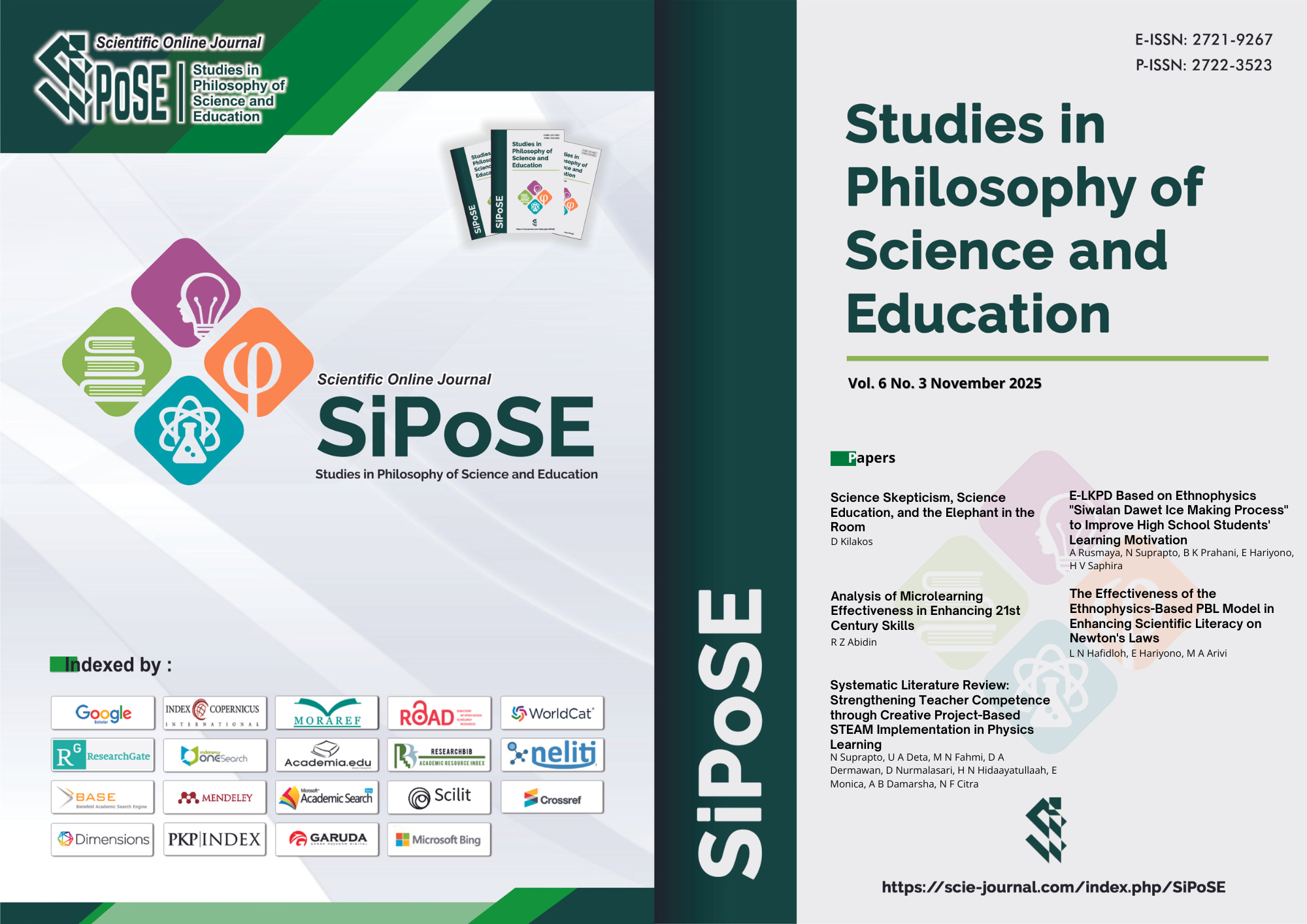
Systematic Literature Review: Strengthening Teacher Competence through Creative Project-Based STEAM Implementation in Physics Learning

Abstract
The STEAM (Science, Technology, Engineering, Arts, and Mathematics) approach is a new form of teaching that places students in real-world situations around them by following the concept of interdisciplinary teaching. STEAM is highly relevant in supporting students' 21st-century skills. As is well known, 21st-century skills encourage students' critical thinking, communication, collaboration, innovation, and creativity. In physics learning, it is not uncommon for students to have difficulty understanding the subject. Teachers, as learning facilitators, are expected to be able to integrate STEAM into physics education. Teachers must have the skills to develop learning tools. Through research using the SLR method, this study aims to investigate the importance of teachers' competencies in implementing project-based STEAM learning in physics education. Project-based learning emphasizes collaborative learning activities among heterogeneous groups of students. The analysis results show that the implementation of the STEAM approach in learning is still limited. Physics teachers are important agents in equipping students with the necessary physics knowledge and scientific investigation skills. Therefore, physics teachers need support in improving their understanding of STEAM. In learning activities involving project-based STEAM, it is known that it can increase students' creativity and innovation in problem solving.
Downloads
References
Anisimova, T. I., Sabirova, F. M., & Shatunova, O. V. (2020). Formation of design and research competencies in future teachers in the framework of STEAM education. International Journal of Emerging Technologies in Learning, 15(2), 204–217. https://doi.org/10.3991/ijet.v15i02.11537
Bassachs, M., Cañabate, D., Nogué, L., Serra, T., Bubnys, R., & Colomer, J. (2020). Fostering critical reflection in primary education through STEAM approaches. Education Sciences, 10(12), 384. https://doi.org/10.3390/educsci10120384
Conradty, C., Sotiriou, S. A., & Bogner, F. X. (2020). How creativity in STEAM modules intervenes with self-efficacy and motivation. Education Sciences, 10(3), 70. https://doi.org/10.3390/educsci10030070
Filipe, J., Baptista, M., & Conceição, T. (2024). Integrated STEAM education for students’ creativity development. Education Sciences, 14(6), 676. https://doi.org/10.3390/educsci14060676
Fitria, T., Kuswanto, H., Dwandaru, W. S. B., Jumadi, J., Putri, D. P. E., & Juneid, A. Z. (2023). Perkembangan penelitian pendekatan STEAM pada pembelajaran fisika di Indonesia: A systematic literature review. Edusains, 15(1), 1–17. https://doi.org/10.15408/es.v15i1.29929
Irdalisa, Amirullah, G., & Dirza, A. F. (2022). Pelatihan pengembangan perangkat pembelajaran berbasis STEAM bagi guru IPA. JMM (Jurnal Masyarakat Mandiri), 6(2), 1393–1401. http://journal.ummat.ac.id/index.php/jmm/article/view/7261
Jamaluddin, F., Saleh, N. M., Abdullah, A., Hassan, M. S., Hamzah, N., Jaffar, R., Abdul Ghani Aziz, S. A., & Embong, Z. (2023). Cooperative governance and cooperative performance: A systematic literature review. SAGE Open, 13(3), 1–21. https://doi.org/10.1177/21582440231192944
Jesionkowska, J., Wild, F., & Deval, Y. (2020). Active learning augmented reality for STEAM education: A case study. Education Sciences, 10(8), 198. https://doi.org/10.3390/educsci10080198
Juškevičiene, A. (2020). STEAM teacher for a day: A case study of teachers’ perspectives on computational thinking. Informatics in Education, 19(1), 33–50. https://doi.org/10.15388/INFEDU.2020.03
Khoiri, N., Roshayanti, F., & Widarti, R. (2023). Integration of STEAM and ESD: Improving the understanding of fluid concepts and creativity. Journal of Education and E-Learning Research, 10(3), 578–584. https://doi.org/10.20448/jeelr.v10i3.4987
Kismawardani, A., Tukiran, & Hariyono, E. (2022). Science technology engineering arts mathematics (STEAM) approach for learning science in junior high school. Studies in Learning and Teaching, 3(1), 55–61. https://doi.org/10.46627/silet.v3i1.101
Kristanti, Y. D., Subiki, & Handayani, R. D. (2016). Project-based learning model in physics learning at senior high school. Jurnal Pembelajaran Fisika, 5(2), 122–128. https://jpf.jurnal.unej.ac.id/index.php/JPF/article/view/3958
Lestari, S. (2021). Development of 21st-century skills orientation in physics learning through PjBL-STEAM assisted by Spectra-Plus. Ideguru: Jurnal Karya Ilmiah Guru, 6(3), 272–279. https://doi.org/10.51169/ideguru.v6i3.243
Liliawati, W., Rusnayati, H., Purwanto, & Aristantia, G. (2017). Implementation of STEAM education to improve mastery of concepts. IOP Conference Series: Materials Science and Engineering, 288(1), 012148. https://doi.org/10.1088/1757-899X/288/1/012148
Montés, N., Aloy, P., Ferrer, T., Romero, P. D., Barquero, S., & Carbonell, A. M. (2022). EXPLORIA: STEAM education at university level as a new way to teach engineering mechanics in an integrated learning process. Applied Sciences, 12(10), 5105. https://doi.org/10.3390/app12105105
Nasri, N. M., Nasri, N., & Talib, M. A. A. (2020). Physics teachers’ perceptions on sustainable physics education. Journal of Baltic Science Education, 19(4), 569–582. https://doi.org/10.33225/jbse/20.19.569
Netshivhumbe, N. P. (2025). Investigating teacher instructional strategies in the teaching of natural sciences in the senior phase. Studies in Learning and Teaching, 6(1), 223–235. https://doi.org/10.46627/silet.v6i1.609
Nihayati, I., & Wulandari, M. P. (2020). The effect of STEAM project-based learning on elementary students’ problem-solving skills. Professions and Professionalism, 10(2), 402–411. https://doi.org/10.7577/pp.4003
Nuraeni, M. I., Wahyuni, S., & Mudakir, I. (2024). Teachers’ perceptions of STEAM-PjBL-oriented science learning integrated with local wisdom. Jurnal Pendidikan dan Pembelajaran IPA Indonesia, 14(3), 120–127. https://doi.org/10.23887/jppii.v14i3.78956
Olivato, J. A., & Silva, J. C. (2023). Interdisciplinary teaching practices in STEAM education in Brazil. London Review of Education, 21(1), 1–13. https://doi.org/10.14324/LRE.21.1.38
Ortiz-Laso, Z., Diego-Mantecón, J. M., Lavicza, Z., & Blanco, T. F. (2023). Teacher growth in exploiting mathematics competencies through STEAM projects. ZDM–Mathematics Education, 55(7), 1283–1297. https://doi.org/10.1007/s11858-023-01528-w
Puspitaningtyas, D., Suryanti, Suprapto, N., & Julianto. (2025). Systematic literature review: Analysis of STEAM-based science learning on improving students’ creativity. Jurnal Kependidikan, 14(2), 2209–2220. https://doi.org/10.58230/27454312.2259
Ramadhan, E. H., & Hindun. (2023). Implementation of project-based learning models to support students’ creative thinking. Protasis: Jurnal Bahasa, Sastra, Budaya, dan Pengajarannya, 2(2), 43–54. https://doi.org/10.55606/protasis.v2i2.98
Rizki, I. A., Setyarsih, W., & Suprapto, N. (2022). A bibliometric study of the project-based learning–STEAM model on students’ critical thinking and scientific literacy. Jurnal Penelitian Ilmu Pendidikan, 15(1), 79–89. https://doi.org/10.21831/jpipfip.v15i1.45403
Sakdiah, H., Ginting, F. W., Rejeki, N. S., & Miranda, A. (2022). STEAM learning on science process skills viewed from students’ scientific attitudes in vocational physics courses. Jurnal Penelitian Pendidikan IPA, 8(5), 2531–2536. https://doi.org/10.29303/jppipa.v8i5.2313
Shi, Y., & Rao, L. (2022). Construction of STEAM graded teaching system using backpropagation neural network model under ability orientation. Scientific Programming, 2022, Article 7792943. https://doi.org/10.1155/2022/7792943
Stracke, C. M., & Trisolini, G. (2021). A systematic literature review on the quality of MOOCs. Sustainability, 13(11), 5817. https://doi.org/10.3390/su13115817
Tm, I. P., Widayati, V., Suyanto, S., & Azra, H. N. (2025). Systematic literature review: Implementation of STEM-based learning approach on students’ interest in biology. BIO-INOVED: Jurnal Biologi-Inovasi Pendidikan, 7(1), 18–26. https://doi.org/10.20527/bino.v7i1.21060
Topalska, R. (2021). STEAM education in the view of the Bulgarian teacher. TEM Journal, 10(4), 1822–1827. https://doi.org/10.18421/TEM104-45
Tuveri, M., Steri, A., & Fadda, D. (2024). Using storytelling to foster the teaching and learning of gravitational waves physics at high school. Physics Education, 59(4), Article 045014. https://doi.org/10.1088/1361-6552/ad4b87
Copyright (c) 2025 Studies in Philosophy of Science and Education

This work is licensed under a Creative Commons Attribution-NonCommercial-NoDerivatives 4.0 International License.
Copyright Notice
The copyright of the received article once accepted for publication shall be assigned to the journal as the publisher of the journal. The intended copyright includes the right to publish the article in various forms (including reprints). The journal maintains the publishing rights to the published articles.