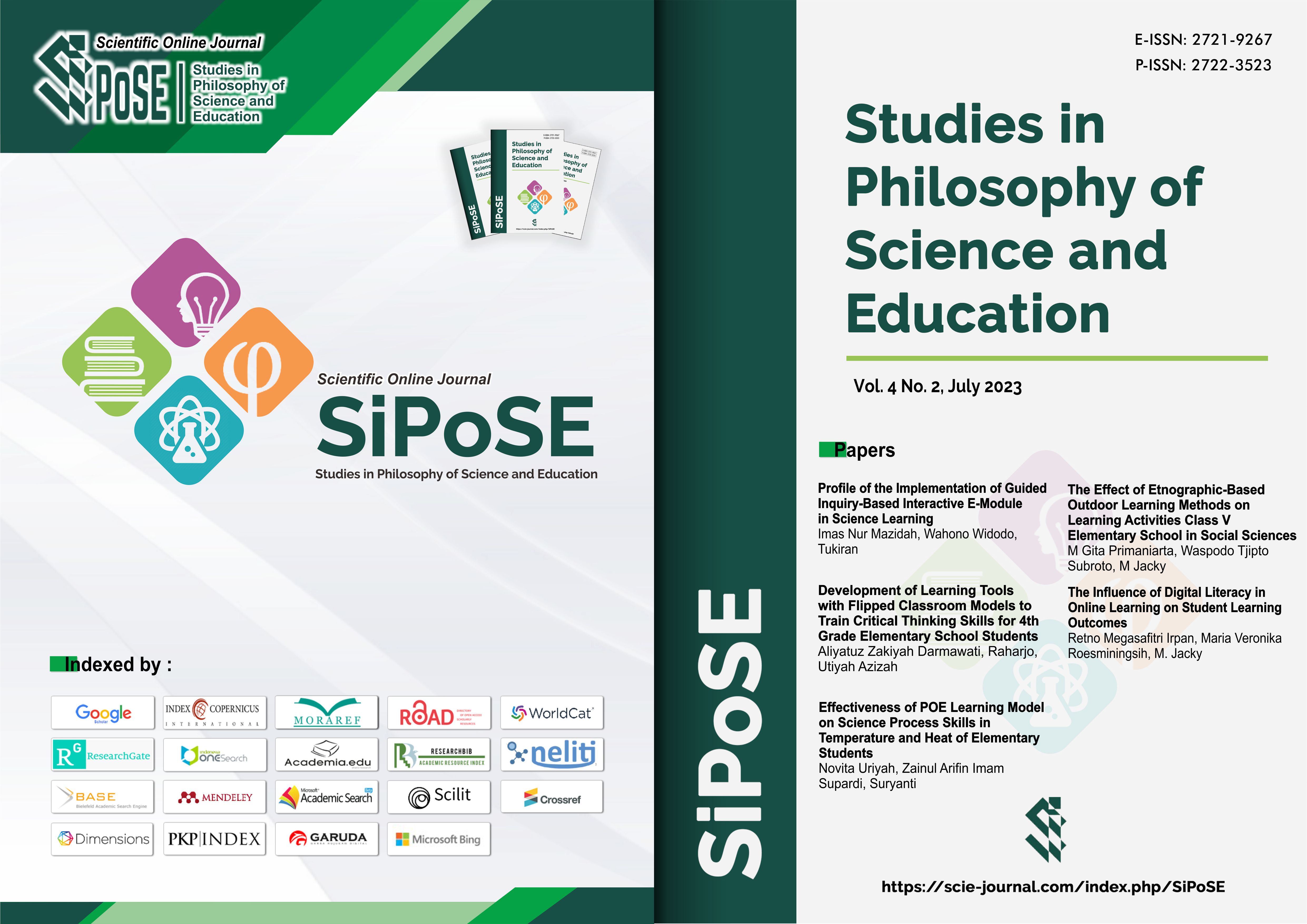
The Effect of Etnographic-Based Outdoor Learning Methods on Learning Activities Class V Elementary School in Social Sciences

Abstract
he ethnographic-based Outdoor learning method is a learning method that conducts learning outside the classroom with a cultural approach in an area. The purpose of this study was to determine the effect of the Outdoor learning method on the activities of fifth grade students. The type of experimental method used is True-experimental through the Posttest Only Control Group Design procedure. The population used was class V at SDN Sidotopo Wetan IV and SDN Sidotopo Wetan V. Trials of questionnaire validation tests for 32 respondents with the provisions of tcount>ttable decided that 10 questionnaire were validated and reliable. The class prerequisite test uses the year-end assessment value using the homogeneity test through SPSS 25 with a value of 0.105>0.005 so that it is homogeneous. Testing the hypothesis through the T-test on the analysis of learning activities using numbers obtained a value of 0.002<0.05 so that Ha decision was accepted. . Based on the results of the study, it can be interpreted that the Ethnographic-Based Outdoor learning method has a positive and significant effect on the activities learning of fifth grade students.
Downloads
References
Azzahra, M., & Amaliyah, N. (2022). Analisis faktor penyebab kesulitan siswa dalam pembelajaran tematik di kelas IV Sekolah Dasar. Jurnal Cakrawala Pendas, 8(3), 851–859. https://doi.org/10.31949/jcp.v8i3.2677
Chusna, L. N., Ekowati, D. W., & Kuncahyono, K. (2019). Modul pendamping pembelajaran tematik berbasis kearifan lokal Blitar di Kelas IV SD. Indonesian Journal of Primary Education, 3(1), 81. https://doi.org/10.17509/ijpe.v3i1.16880
Creswell, J. W., & Poth, C. N. (2016). Qualitative inquiry and research design: Choosing among five approaches. Sage publications.
Fariana, R. E., Surindra, B., & Arifin, Z. (2021). The influence of financial literacy, lifestyle and self-control on the consumption behavior of economic education student. International Journal of Research and Review, 8(8), 496–503. https://doi.org/10.52403/ijrr.20210867
Firmansyah, L. (2019). Pengaruh metode outdoor study terhadap keterampilan menulis puisi siswa kelas IV SDN Leminggir Kecamatan Mojosari Kabupaten Mojokerto. Jurnal Penelitian Pendidikan Guru Sekolah Dasar.
Fouryza, D., Amin, S. M., & Ekawati, R. (2019). Designing lesson plan of integer number operation based on fun and easy math (FEM) approach. International Journal of Evaluation and Research in Education, 8(1), 103–109. https://doi.org/10.11591/ijere.v8i1.15514
Hammersley, M. (2021). Classroom ethnography: Empirical and methodological essays. Routledge.
Husamah. (2013). Pembelajaran luar kelas outdoor learning: Ancangan strategis mengembangkan metode pembelajaran yang menyenangkan, inovatif, menantang. Prestasi Pustaka.
Jacky, M., Sadewo, F. S., Harianto, S., Sudrajat, A., Noor, M. M., & Fenoughty, D. (2021). Work from home: Social media, virtual meeting and the new family relationship. The Journal of Society and Media, 5(2), 285–310. https://doi.org/10.26740/jsm.v5n2.p285-310
Koentjaraningrat. (2009). Pengantar ilmu antropologi. Rineka cipta.
Kurniangsih, A., Darsiharjo, D., & Maryani, E. (2016). Penggunaan metode pembelajaran outdoor study terhadap pemahaman konsep pelestarian lingkungan hidup peserta didik di MTSN Singaparna. Jurnal Geografi Gea, 15(1), 9–16. https://doi.org/10.17509/gea.v15i1.4180
Macniven, R., Canuto, K., Wilson, R., Bauman, A., & Evans, J. (2019). The impact of physical activity and sport on social outcomes among Aboriginal and Torres Strait Islander people: A systematic scoping review. Journal of Science and Medicine in Sport, 22(11), 1232–1242. https://doi.org/10.1016/j.jsams.2019.06.017
Mariana, N. (2017). Transforming mathematics problems in Indonesian primary schools by embedding Islamic and Indonesian contexts [Doctoral dissertation, Murdoch University]. https://researchportal.murdoch.edu.au/esploro/outputs/991005540746707891
Mariyani, A. (2019). Analisis kemampuan inovasi pembelajaran guru sekolah dasar dalam implementasi pembelajaran tematik Kurikulum 2013 di Sekolah Dasar. Profesi Pendidikan Dasar, 1(2), 189–198. https://doi.org/10.23917/ppd.v1i2.9028
Mustika, D., Ambiyar, A., & Aziz, I. (2021). Proses penilaian hasil belajar Kurikulum 2013 di Sekolah Dasar. Jurnal Basicedu, 5(6), 6158–6167. https://doi.org/10.31004/basicedu.v5i6.1819
Mytra, P., Asrafiani, A., Budi, A., Hardiana, H., & Irmayanti, I. (2022). Implementasi teori belajar behavioristik dalam pembelajaran matematika. JTMT: Journal Tadris Matematika, 3(2), 45–54. https://doi.org/10.47435/jtmt.v3i2.1253
Nugraha, R. S., Sumardi, S., & Hamdu, G. (2017). Desain pembelajaran tematik berbasis outdoor learning di SD. Indonesian Journal of Primary Education, 1(1), 34. https://doi.org/10.17509/ijpe.v1i1.7495
Ordov, K., Madiyarova, A., Ermilov, V., Tovma, N., & Murzagulova, M. (2019). New trends in education as the aspect of digital technologies. International Journal of Mechanical Engineering and Technology, 10(2), 1319–1330.
Primaniarta, M. G., & Subrata, H. (2022). Development of Kidung Jula-Juli as a media for children’s literacy. Premiere Educandum: Jurnal Pendidikan Dasar dan Pembelajaran, 12(2), 174–186. https://doi.org/10.25273/pe.v12i2.12947
Rahmi, P., & Hijriati. (2021). Proses belajar anak usia 0 sampai 12 tahun berdasarkan karakteristik perkembangannya. Jurnal Pendidikan Anak Bunayya, 7(1), 141–154.
Rasmitadila, R., Aliyyah, R. R., Rachmadtullah, R., Samsudin, A., Syaodih, E., Nurtanto, M., & Tambunan, A. R. S. (2020). The perceptions of primary school teachers of online learning during the COVID-19 pandemic period. Journal of Ethnic and Cultural Studies, 7(2), 90–109.
Saputra, W. S., Badeni, & Djuwita, P. (2022). Analisis rencana pelaksanaan pembelajaran tematik muatan pelajaran ips pada masa pandemi covid-19 di sd it teladan kecamatan kota agung kabupaten tanggamus provinsi lampung. Jurnal Kajian Pendidikan Dasar (Kapedas), 1(2), 140–149. https://doi.org/10.33369/kapedas.v1i2.21615
Setyowati, R. N., Nurhasan, Sarmini, & Herianto, E. (2022). Multicultural education in indonesia as a function of curriculum development strategies, students’ cultural competencies and globalization. Przestrzen Spoleczna, 23(2), 114–136. https://doi.org/10.12738/jestp.2022.2.0016
Sholahuddin, A., Fitriyana, R., Sya’ban, M. F., & Sadiqin, I. K. (2021). Students' caring attitudes to wetland environment: A case of environmental education in Banjar district Indonesia. Jurnal Pendidikan IPA Indonesia, 10(1), 149–158. https://doi.org/10.15294/jpii.v10i1.27838
Subroto, W. T. (2015). Menanamkan nilai-nilai entrepreneurship melalui pendidikan ekonomi pada era masyarakat ekonomi Asean. Jurnal Economia, 11(1), 16. https://doi.org/10.21831/economia.v11i1.7751
Sudjana, N. (2013). Penilaian hasil proses belajar mengajar. Rosdakarya.
Sugiyono. (2013). Metode penelitian pendidikan pendeatan kuantitatif, kualitatif. Alfabeta.
Sugiyono. (2016). Metode penelitian kuantitatif. kualitatif, dan R&D. Alfabeta.
Suharwati, S. I., & Rahman, A. M. (2018). Menumbuhkan karakter cinta lingkungan dalam pembelajaran IPS di sekolah dasar melalui outdoor study. Penguatan Pendidikan IPS di Tengah Isu-Isu Global, 253–260. https://docplayer.info/94576468-Penguatan-pendidikan-ips-di-tengah-isu-isu-global.html
Sulestiani, A., Baroroh, I., Ekowanti, M. R. L., & Budiman, K. (2017). Penguatan teknologi pengolahan kerang di kedung cowek, kecamatan bulak Surabaya. Agritrop, 15(1), 152–161.
Suwaib, S., Riyanto, Y., & Subroto, W. T. (2020). Penerapan model problem-based learning berbantuan metode mind mapping untuk meningkatkan aktivitas dan hasil belajar ips peserta didik kelas iv sd negeri 002 sebatik utara kabupaten nunukan. Jurnal Review Pendidikan Dasar : Jurnal Kajian Pendidikan Dan Hasil Penelitian, 6(2), 163–173. https://doi.org/10.26740/jrpd.v6n2.p163-173
Widiastuti, E. H. (2017). Pemanfaatan lingkungan sebagai sumber pembelajaran mata pelajaran IPS. Satya Widya, 33(1), 29. https://doi.org/10.24246/j.sw.2017.v33.i1.p29-36
Wiryanto, Primaniarta, M. G., & Mattos, R. L. de. (2022). Javanese ethnomathematics: Exploration of the Tedhak Siten tradition for class learning practices. Journal on Mathematics Education, 13(4 SE-Articles), 661–680. https://doi.org/10.22342/jme.v13i4.pp661-680
Wulandari, R. (2016). Metode kunjungan lapangan untuk menanamkan kepedulian terhadap lingkungan hidup. PEDAGOGIA: Jurnal Pendidikan, 5(1), 67. https://doi.org/10.21070/pedagogia.v5i1.90
Copyright (c) 2023 Studies in Philosophy of Science and Education

This work is licensed under a Creative Commons Attribution-NonCommercial-NoDerivatives 4.0 International License.
Copyright Notice
The copyright of the received article once accepted for publication shall be assigned to the journal as the publisher of the journal. The intended copyright includes the right to publish the article in various forms (including reprints). The journal maintains the publishing rights to the published articles.