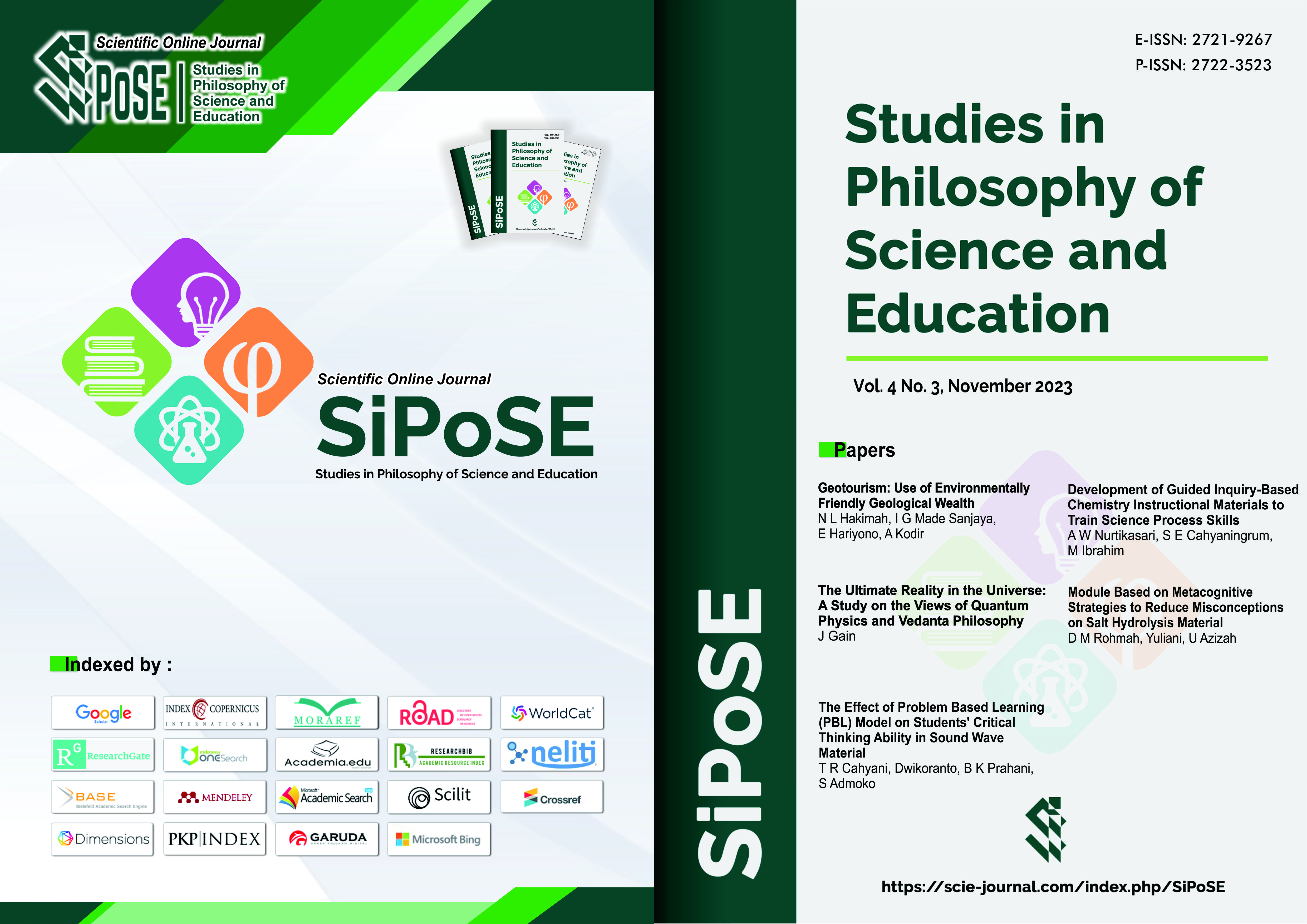
Module Based on Metacognitive Strategies to Reduce Misconceptions on Salt Hydrolysis Material

Abstract
The use of modules allows students to learn independently according to their abilities and interests, but it can also develop the ability to interact directly with the environment and other learning resources. This study aims to produce a module based on metacognitive strategies to reduce misconceptions on salt hydrolysis material. This research is a Research and Development by adapting the research and development stages modified by Sukmadinata with one group pretest-posttest design which is treated with a limited trial sample of 20 students of class XI MIPA at SMAN 1 Lamongan. The research instrument used was students' conception test sheets given before and after learning with the number of items, namely 5 reasoned multiple-choice questions accompanied by CRI (Certainty of Response Index). The results showed that in the concept of the hydrolysis reaction there was a change in misconception (MK) to know the concept (TK) by 74%, to not know the concept (TTK) by 0%, and still have a misconception (MK) by 26%. In the concept of salt solution pH there is a shift to TK, TTK, and MK respectively by 50%, 0%, and 50%. Thus, it can be concluded that modules based on metacognitive strategies can reduce misconceptions about the concept of hydrolysis reactions by 74% and about the concept of pH of salt solutions by 50%.
Downloads
References
Ahlif, U. F., Samsudin, A., & Suhendi, E. (2014). Analisis penurunan miskonsepsi siswa setelah mengikuti pembelajaran kooperatif tipe STAD berbatuan simulasi komputer. Jurnal Pendidikan Fisika Tadulako (JPFT), 2(3), 57-59.
Anwarudin, A., Nuswowari, M., & Widiarti, N. (2019). Analisis miskonsepsi peserta didik pada materi hidrolisis garam melalui tes diagnostik. Chemistry in Education, 8(1), 1-7.
Arikunto, S. (2010). Prosedur penelitian: Suatu pendekatan praktek. Rineka Cipta.
Arni, Jahidin, & Suriana. (2019). Pengaruh strategi belajar M3K (Membaca, Mengidentifikasi, dan Menguji Konsep)-Metakognisi dalam meningkatkan pemahaman konsep dan mereduksi miskonsepsi materi sistem ekskresi siswa. Jurnal Biofiskim, 1(1), 10-19. https://doi.org/10.33772/biofiskim.v1i1.7172
Banerjee, A. C. & Power, C. N. (2007). The development of modules for the teaching of chemical equilibrium. International Journal of Science Education, 3, 355-362.
Barke, H. D., Al-Hazar, A., & Yitbarek, S. (2009). Misconceptions in chemsitry, addresing perceptions in chemical education. Springer Verlag.
Cakmakci, G., & Aydogdu, C. (2011). Designing and evaluating an evidence informed instruction in chemical kinetics. Chemistry Education Research and Practice, 15-28. https://doi.org/10.1039/C1RP90004H
Djamarah, S. B., & Zain, A. (2010). Strategi belajar mengajar. Rineka Cipta.
Fresenborg, E. C. & Kaune, C. (2011). Development of metacognitive and discursive activities in Indonesian maths teaching. Journal of Mathematics Education, 2(1), 15-40. https://doi.org/10.22342/jme.3.1.619.1-16
Gay, L. R., & Diehl, P. L. (1992). Research methods for business and management. New York Macmillan Publishing Company.
Harrison, A.G. & Treagust, D. F. (1999). Secondary students’ mental models of atoms and molecules: implication for teaching chemstry. Science Education, 80(5), 294-299. https://doi.org/10.1002/(SICI)1098-237X(199609)80:5%3C509::AID-SCE2%3E3.0.CO;2-F
Hasan, S., Bagayoko, D., & Kelley, E. L. (1999). Misconceptions and the Certainty of Response Index (CRI). Physics Education, 34, 294-299. https://10.1088/0031-9120/34/5/304
Ibrahim, M. (2012). Konsep, miskonsepsi, dan cara pembelajarannya. Unesa Unversity Press.
Lasmiyati & Harta, I. (2014). Pengembangan modul pembelajaran untuk meningkatkan pemahaman konsep dan minat SMP. Phytagoras: Jurnal Pendidikan Matematika, 161-174. https://doi.org/10.21831/pg.v9i2.9077
Nasrudin, H., & Azizah, U. (2020). Overcoming misconception in energetic topics through implementation of metacognitive skills-based instructional materials: A case in strudent of chemistry department, Universitas Negeri Surabaya. JPII, 125-134. https://doi.org/10.15294/jpii.v9i1.21630
Novak, J. D. (2011). A theory of education: Meaningful learning underlies the constructive integration to empowerment for commitment and responsibility. Meaningful Learning Review, 1(2), 1-14. https://10.12691/education-5-4-13
Pikoli, M. & Sihaloho, M. (2014). Implementasi pembelajaran dengan menginterkoneksikan multiple representatif pada materi hidrolisis garam untuk mereduksi miskonsepsi siswa. Prosiding Seminar Nasional Kimia Jurusan Kimia FMIPA Universitas Negeri Surabaya.
Prastowo, A. (2015). Panduan kreatif membuat bahan ajar inovatif: Menciptakan metode pembelajaran yang menarik dan menyenangkan. DIVA Press.
Priyasmika, R., & Sholichah, N. (2022). Analisis miskonsepsi pada materi hidrolisis garam menggunakan instrumen tes diagnostik four tier. Jurnal Riset Teknologi dan Inovasi Pendidikan, 5(1), 19-28.
Purwanto, Y. & Rizki, S. (2015). Pengembangan bagan ajar berbasis kontekstual pada materi himpunana berbantu video pembelajaran. AKSIOMA Jurnal Program Studi Pendidikan Matematika, 4(1). https://doi.org/10.24127/ajpm.v4i1.95
Pope, K. C. (2011). Metacognitif development in a collage level geometry course for preservice elementary teachers: A case study [Doctoral dissertation, Oklahoma State University]. https://shareok.org/handle/11244/7537
Rahmawati, R. A. (2016). Pengaruh modul dan LKS pada materi ciri-ciri makhluk hidup terhadap hasil belajar IPA siswa kelas VII SMP Negeri 1 Nguntoronadi Wonogiri tahun pelajaran 2015/2016 [Undergraduate honors thesis, Universitas Muhammadiyah Surakarta]. https://eprints.ums.ac.id/44009/
Salirawati, D., & Wiyarsi, A. (2012). Pengembangan instrumen pendeteksi miskonsepsi materi ikatan kimia untuk peserta didik. Jurnal Kependidikan, 42, 118-129. https://doi.org/10.21831/jk.v42i2.2238
Sriatun, N. (2009). Remediasi miskonsepsi siswa pada materi kalor menggunakan model pencapaian konsep di kelas VII SMP 14 Pontianak. FKIP UNTAN.
Sukmadinata, N. S. (2005). Metode penelitian pendidikan. Remaja Rosadakarya.
Suparno, P. (2013). Miskonsepsi & perubahan konsep dalam pendidikan fisika. PT. Grasindo.
Syahrul, D. A. & Setyarsih, W. (2015). Identifikasi miskonsepsi dan penyebab miskonsepsi siswa dengan three-tier diagnostic test pada materi dinamika rotasi. Jurnal Inovasi Pendidikan Fisika (JIPF), 4(3).
Copyright (c) 2023 Studies in Philosophy of Science and Education

This work is licensed under a Creative Commons Attribution-NonCommercial-NoDerivatives 4.0 International License.
Copyright Notice
The copyright of the received article once accepted for publication shall be assigned to the journal as the publisher of the journal. The intended copyright includes the right to publish the article in various forms (including reprints). The journal maintains the publishing rights to the published articles.