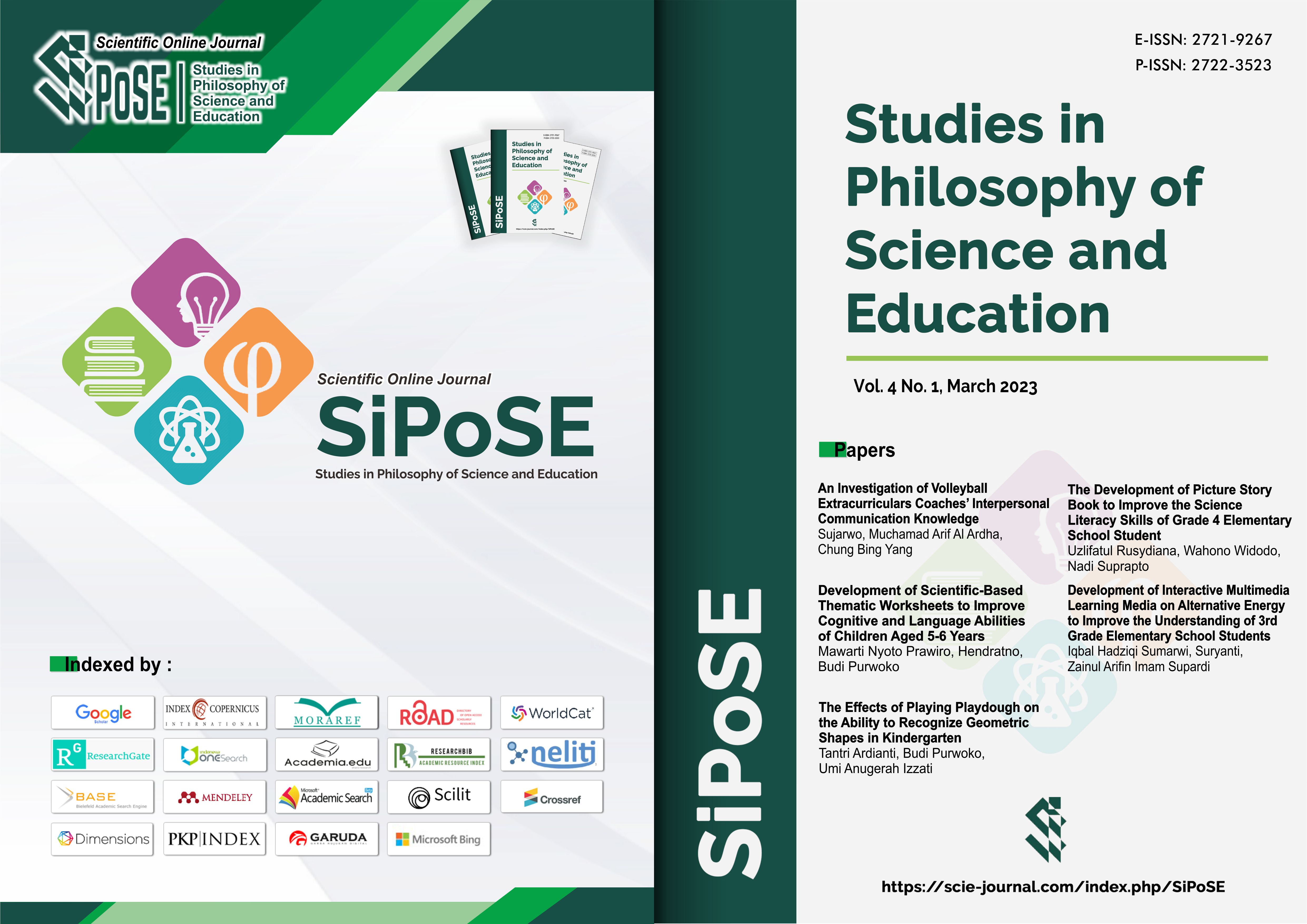
The Effects of Playing Playdough on the Ability to Recognize Geometric Shapes in Kindergarten

Abstract
The ability to recognize geometric shapes is still lacking, such as children who have not been able to classify objects based on shape, color, and color pattern. This study uses a quantitative approach with a quasi-experimental design. The experimental design used was a nonequivalent control group design with 32 children as research subjects carried out at RA Ashyubbani Changing. this study used parametric statistical data analysis techniques using the ANOVA test. The conclusions of this study indicate that there is an effect of playing with plasticine on the ability to recognize geometric shapes in group A Kindergarten. The results showed a correlation coefficient 0.526 with a significance level of 0.006 which is less than 5%; this shows that there is an effect of playing with plasticine on the ability to recognize geometric shapes in group A kindergarten children. Playdough activities can improve children's abilities to recognize geometric shapes both in grouping objects based on shape, color, and color pattern.
Downloads
References
Ardini, P. P. (2018). Bermain dan permainan anak usia dini (Sebuah kajian teori dan praktik). Adjie Media Nusantara.
Creswell, J. W., & Creswell, J. D. (2017). Research design: Qualitative, quantitative, and mixed methods approaches. SAGE Publications.
Fischer, U., Suggate, S. P., & Stoeger, H. (2020). The implicit contribution of fine motor skills to mathematical insight in early childhood. Frontiers in Psychology, 11, 1143.
Sari, Y. K., Sukartiningsih, W., & Jannah, M. (2018). The effect of geometric puzzle game towards children’s recognition of geometric shapes and fine motor. Proceedings of the 2nd International Conference on Education Innovation (ICEI 2018), 340-342. https://doi.org/10.2991/icei-18.2018.75
Setiawati, E. (2022). The effect of playdough games on children's creativity in early childhood education. Gagasan Pendidikan Indonesia, 3(1). https://doi.org/10.30870/gpi.v3i1.15122
Siregar, S. (2013). Statistik parametrik untuk penelitian kuantitatif dilengkapi dengan perhitungan manual dan aplikasi SPSS versi 17. Bumi Aksara.
Sugiyono. (2013). Metode penelitian kuantitatif, kualitatif dan R&D. Alfabeta.
Suryameng. (2016). Peningkatan keterampilan motorik halus kelompok A melalui bermain playdough. JPPM (Jurnal Pendidikan dan Pemberdayaan Masyarakat), 3(2), 197-206. https://doi.org/10.21831/jppm.v3i2.10031
Sutapa, P., Prasetyo, Y., Arjuna, F., & Prihatanta, H. (2018). Differences of influence of playing playdough and puzzles on fine motorcycle skills and logical- mathematical intelligence in early childhood. Proceedings of the 2nd Yogyakarta International Seminar on Health, Physical Education, and Sport Science (YISHPESS 2018) and 1st Conference on Interdisciplinary Approach in Sports (CoIS 2018), 171-174. Atlantis press. https://doi.org/10.2991/yishpess-cois-18.2018.44
Tarigan, D. (2015). Pembelajaran discovery matematika di sekolah dasar. Jurnal Pengabdian Kepada Masyarakat, 21(79), 9-16.
Triharso, A. (2013). Permainan kreatif & edukatif untuk anak usia dini [Creative and educational games for early childhood] . CV Andi Offset.
Copyright (c) 2023 Studies in Philosophy of Science and Education

This work is licensed under a Creative Commons Attribution-NonCommercial-NoDerivatives 4.0 International License.
Copyright Notice
The copyright of the received article once accepted for publication shall be assigned to the journal as the publisher of the journal. The intended copyright includes the right to publish the article in various forms (including reprints). The journal maintains the publishing rights to the published articles.