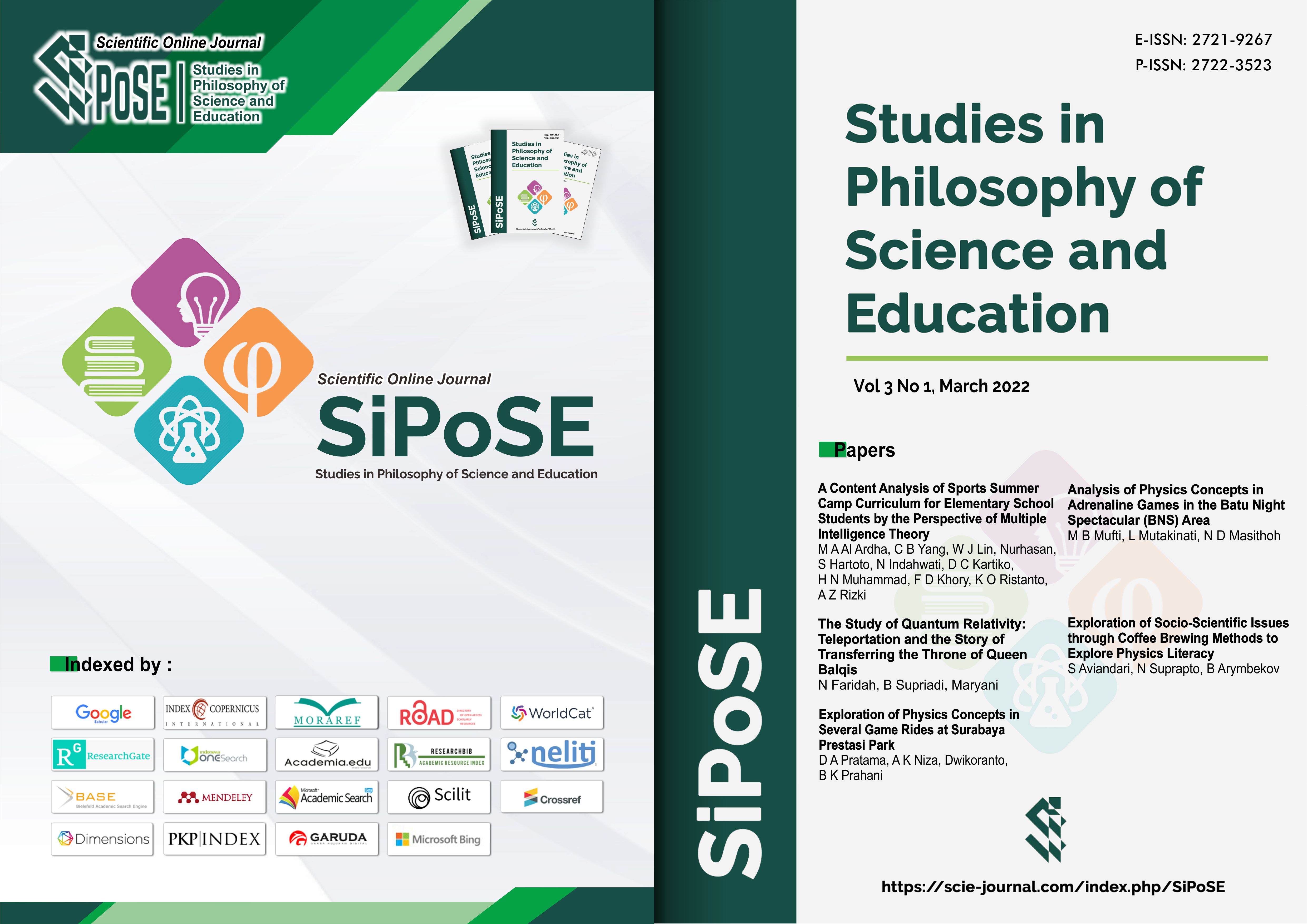
Analysis of Physics Concepts in Adrenaline Games in the Batu Night Spectacular (BNS) Area

Abstract
Adrenaline games are often found in amusement parks, because adrenaline games are one of the keys to attracting people's attention. Indonesia has many entertainment venues spread across various regions. One example of an amusement park in Indonesia is Batu Night Spectacular (BNS). BNS is one of the tourist sites in the city of Malang, East Java, to be precise in the city of Batu. This study aims to analyze the concept of physics in adrenaline games at BNS. The games that will be analyzed are Mega Disco, Crazy Bike, Drop N'Twist, and Gravitron. This research is a qualitative descriptive research using literature review and observation methods. Based on the literature review and observations that have been made, it was found that in the Mega Disco game there is a physics concept of oscillatory motion and rotational motion. Rotational motion is shown by repeated movements to the right and left, while rotational motion is shown in the rotation experienced by visitors' seats. In the Crazy Bike game there is a simple pendulum physics concept and circular motion. A simple pendulum is shown in a swinging motion with a connecting arm, while circular motion is shown in a crazy bicycle swinging 360 ⁰ . In the Drop N'Twist game, there are concepts that are free fall and vertical upward motion. The Gravitron game has the main concept of three forces that occur, namely gravity , frictional force , and normal force . Gravity is influenced by gravity on a band, and frictional force opposes the motion of gravity so that visitors don't fall down . normal motion is towards the center to maintain the visitor's position while the gravitron rotates.
Downloads
References
Abdullah, M. (2016). Fisika Dasar I. Bandung: Institut Teknologi Bandung, 201.
Arzak, K. A., Neswary, S. B. A., & Fitriyah, H. (2021). Analysis of the Use of Circular Motion Physics Concepts on Game Rides in Jawa Timur Park 1. Studies in Philosophy of Science and Education, 2(2), 1-11. https://doi.org/10.46627/sipose.v2i2.107
Dean, S. N. (2021). National Park interpretation and place-based education: An integrative literature review. Journal of Experiential Education, 44(4), 363-377.
Gabdrakhmanov, N. K., Ulengov, R. A., & Hadiullina, R. R. (2016). Integration of comprehensive and innovative approach in teaching studentssportsmen. Journal of Economics and Economic Education Research, 17(1), 38.
Haverlíková, V. (2011). SCHOLA LUDUS serious educational games The problem of mechanic balancing in virtual and real games. In 2011 14th International Conference on Interactive Collaborative Learning (pp. 615-619). IEEE. 10.1109/ICL.2011.6059660
Indriati, N. O., Listiantomo, D. P., Aprilia, F. D., & Prahani, B. K. (2021). Study of Physics Learning in Indoor Games at Transmart Surabaya. Studies in Philosophy of Science and Education, 2(2), 33-46. https://doi.org/10.46627/sipose.v2i2.123
Johra, H., Petrova, E. A., Rohde, L., & Pomianowski, M. Z. (2021). Digital twins of building physics experimental laboratory setups for effective e-learning. In Journal of Physics: Conference Series (Vol. 2069, No. 1, p. 012190). IOP Publishing.
Keller, D. M. (2017). Place-based education: a look at its potential benefits to our students and our places through case study research and the literature. Interdisciplinary Environmental Review, 18(3-4), 220-237. https://doi.org/10.1504/IER.2017.088746
Mavhunga, F., & Kibirige, I. (2018). Tapping the tacit knowledge of playfield swings to learn physics: A case study of childhood reflections by pre-service teachers. African Journal of Research in Mathematics, Science and Technology Education, 22(2), 221-230. https://doi.org/10.1080/18117295.2018.1479620
Miller, D., & Twum, S. (2017). The Experiences of Selected Teachers in Implementing Place-Based Education. in education, 23(1), 92-108. https://doi.org/10.37119/ojs2017.v23i1.282
Nichols, J. B., Howson, P. H., Mulrey, B. C., Ackerman, A., & Gately, S. E. (2016). The promise of place: Using place-based education principles to enhance learning. The International Journal of Pedagogy and Curriculum, 23(2), 27. https://doi.org/0.18848/2327-7963/CGP/v23i02/27-41
Popov, O. 2006. Developing Outdoor Activities and a Website as resources to Stimulate Learning Physics in Teacher Education. Journal Physics Teacher, 3(3),18-23
Suprapto, N., & Mubarok, H. (2020). The physics of Gravitram:“Leisure or outdoor learning?”. In Proceedings of the 7th Mathematics, Science, and Computer Science Education International Seminar, MSCEIS 2019, 12 October 2019, Bandung, West Java, Indonesia. http://dx.doi.org/10.4108/eai.12-10-2019.2296471
Suprapto, N., Sunarti, T., Adam, A. S., & Mubarok, H. (2021). Learning from Technopark: Exploring of Physics Concept Through Advanced Technology. International Joint Conference on Science and Engineering 2021 (IJCSE 2021), 642-648. https://doi.org/10.2991/aer.k.211215.107
Wang, Y. L., Liang, J. C., Lin, C. Y., & Tsai, C. C. (2017). Identifying Taiwanese junior-high school students' mathematics learning profiles and their roles in mathematics learning self-efficacy and academic performance. Learning and Individual Differences, 54, 92-101. https://doi.org/10.1016/j.lindif.2017.01.008
Copyright (c) 2022 Studies in Philosophy of Science and Education

This work is licensed under a Creative Commons Attribution-NonCommercial-NoDerivatives 4.0 International License.
Copyright Notice
The copyright of the received article once accepted for publication shall be assigned to the journal as the publisher of the journal. The intended copyright includes the right to publish the article in various forms (including reprints). The journal maintains the publishing rights to the published articles.